You paid more for the down pillow because it's the real thing, and it flattens out like paper a few minutes after your head lands on it. Or you went the other way, bought the down alternative, and it feels like sleeping on a plastic bag. Sound familiar?
After a million pillows sold and thousands of conversations with our customers using down and down alternative, we know which one is better for which sleeper, and which one ends up getting replaced. We checked that against what buyers write on Amazon and Trustpilot and what Redditors say in the bedding forums, including the latest from 2026.
Below we break down what each one is made of, which goes flat first, which sleeps cooler, which is safer for allergies, and which one you'll resent on laundry day.
TL;DR (Down vs Down Alternative)
- Made of: down is the cluster layer under duck or goose feathers. Down alternative is polyester fiber. It's synthetic, and there's no getting around that.
- Goes flat first: cheap unnamed polyester, every time. Good synthetic holds one height, and down squashes but puffs back up if you fluff it.
- Lasts longest: down, by a wide margin, but only if you wash and tumble it. People keep these ten, twenty, thirty years. Left alone it flattens in one or two.
- Sleeps cooler: down, as a fiber. But the cover matters more than the fill, and a waterproof protector sleeps hot whichever fill is under it.
- Allergies: down alternative, if feathers are the problem. Neither fill does anything about dust mites.
- Washing: down alternative, and it's not close. Synthetic washes and dries in a cycle. Down can take days and smells until it's fully dry.
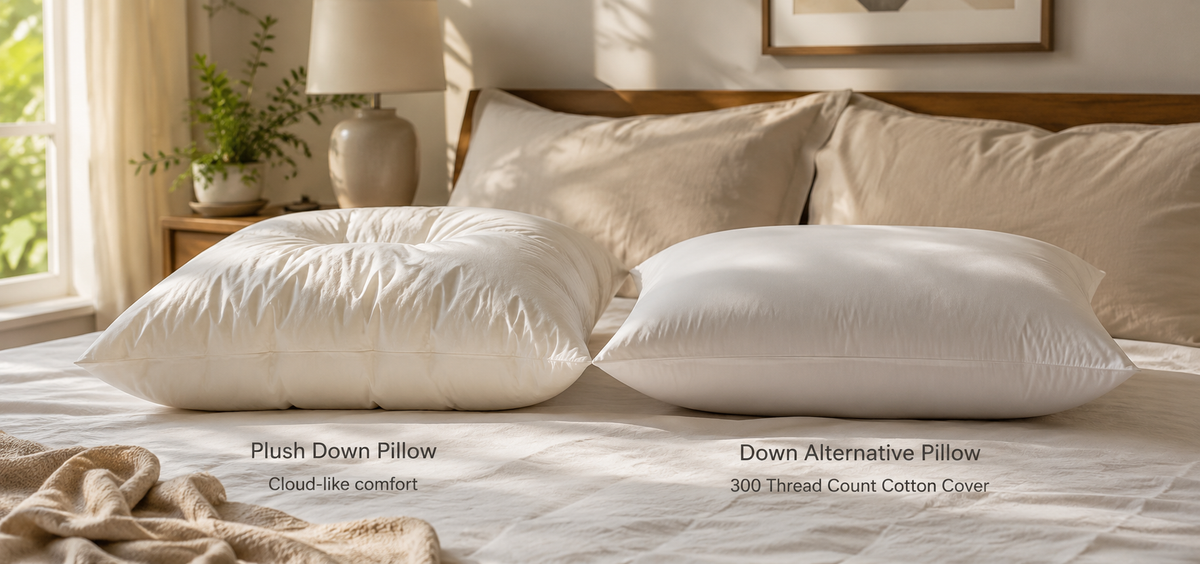
- Price: the FluffCo Down Alternative Pillow is $69. The FluffCo Down Feather Pillow is $119.
One thing up front: we sell pillows, so weigh our picks accordingly. Where ours falls short, that's below too.
How to Choose Between Down and Down Alternative
If you're standing between the two and not sure which one to buy, here's how you choose:
Choose a DOWN ALTERNATIVE PILLOW if:
- You have a feather allergy, or quills have worked through a pillow on you before
- You want a vegan fill
- You wash your pillows and don't want drying one to turn into a weekend job
- You want four to six good years without fluffing or washing it on a schedule
- You won't stand over a dryer for hours breaking up clumps by hand
- You want one height that stays that height, with no fluffing or topping up
- You run hot, and you'll put a cotton case on it rather than expect the fill to fix that
- You want the tag to name the fiber, hollowfibre or spiral fibre or microfibre, not just say polyester
- You want an Oeko-Tex certified fill, if what's in your bedding matters to you
- You're spending under $100
Choose a DOWN AND FEATHER PILLOW if:
- You want to sink into it, and you'll shake it out every morning to bring it back
- You like shaping a divot where your ear sits
- You want the down feel without pure-down pricing
- You sleep cold and want a fill that holds body heat
- You'll keep a washable protector on it, since the pillow itself stays out of the machine
- You'd rather buy one pillow for the next decade than a new one every few years
- You aren't bothered by the occasional quill working through the shell
Choose PURE DOWN, 80 percent or higher, if:
- You want a pillow that can still be good in twenty years, and you'll do the washing that takes
- Quills have put you off blends before, since a higher down ratio means fewer of them
- You want a fill that puffs back up on its own overnight instead of staying flat
- You're comfortable paying two or three times the price of a synthetic
- You have somewhere to hang or tumble a pillow for hours after washing
- You sweat at night and want a fill that lets it escape instead of holding it against you
One thing before you pick: FluffCo makes the first two, not the third.
Down vs Down Alternative: What Are They Made Of?
Down is made of the soft cluster layer that sits under the outer feathers of a duck or goose, and down alternative is made of polyester fiber built to copy it. That's the only real difference between them, and everything else follows from it: how it sleeps, how fast it flattens, what happens on wash day.
The shape of the fiber is what everything else follows from:
- Down clusters branch out in every direction and trap air in the gaps, which is why so little of it fills so much space
- Hollow or spiralled polyester holds air the same way and puffs back up after you squash it
- Flat, short, cheap polyester catches on itself, locks together and packs down
That last difference almost never makes it onto a label, which is why two pillows with the same wording on the tag behave nothing alike.
Is down alternative better than polyester?
Down alternative is better than plain polyester only when the maker used a better fiber, and it's all polyester underneath either way. Buyers who call it plastic are using an accurate word, and there's no point arguing the label.
What's worth arguing about is how much varies under that one name. Cheap synthetic goes in as a puffy polyester mass and flattens into batting; a good one keeps its shape for years. Both sit on shelves labelled down alternative at prices from twenty to a hundred dollars.
So the question isn't whether your pillow is synthetic. It's whether the maker told you which synthetic.
What is in your pillow, and how to read the fill line
To find out what's in your pillow, read the fill line on the tag before the marketing on the front. A vague fill line tells you plenty. Brands that use a better fiber name it. Brands that use commodity fill write polyester and stop.
- A named fiber beats an unnamed one. Hollowfibre, spiral fibre, microfibre or a branded fill tells you the maker had something to point at. A tag that just says polyester is the cheap one
- A stated fill weight or firmness level beats soft or firm alone
- A real shell spec with a fiber and a thread count, ideally cotton. Past about 400 to 500 the thread count stops telling you much, so read the weave and the fiber instead
- A finished edge, double-needle or piped, which stops the fill working its way into the corners
On the down side the number that matters is the down-to-feather ratio. A pillow needs to be at least 80 percent down to be sold as down, and anything below that's a down and feather blend, which is the reason quills work through the shell and poke you. If a listing says 75 percent, that's a blend wearing a down label.
|
Fill type |
What it is |
Goes flat |
Heat |
Allergies |
Washing |
Price band |
Best for |
|---|---|---|---|---|---|---|---|
|
Down (goose or duck clusters) |
Natural cluster layer, at least 80 percent down to count |
Decades if you wash and tumble it, a year or two if you don't |
Breathes well, moves moisture off the head |
Feather protein reacts; quills can pierce the shell |
Washes easily, dries slowly, smells until bone dry |
$100 and up (FluffCo Down Feather $119) |
People who'll wash it twice a year and tumble it dry |
|
Down alternative (hollowfibre or microfibre) |
Hollow or spiralled polyester that traps air and puffs back up |
Four to six years on the good ones, well under a year on the bad |
Depends almost entirely on the shell |
Hypoallergenic, no feather protein, no quills |
Normal wash and dryer cycle, no clumps to break up |
$40 to $90 (FluffCo Down Alternative $69) |
Most sleepers, allergy sufferers, anyone who washes bedding |
|
Cheap polyester, sold unnamed |
Short flat fibers with nothing holding them apart |
Mats into batting and clumps toward the corners, sometimes inside a year |
Traps heat when packed into a tight synthetic shell |
Hypoallergenic, same as any synthetic |
Washable, but often comes out lumpy and stays lumpy |
Under $30 |
Guest beds and short-term use |
Is down alternative healthy, and does it have microplastics?
Down alternative is polyester, so it does shed fibers over time, and that's the honest basis for the microplastics question. How much it matters is where people split, and both camps are worth hearing.
The skeptics point out that a fill sealed inside a shell and a pillowcase isn't reaching you in any meaningful quantity, and that the alarm belongs to memory foam off-gassing rather than fiber fill. The cautious side counts pillows among the synthetics in the house and would rather not add another.
IF that question bothers you, buy on certification rather than fill type. Oeko-Tex means the textile was tested for harmful substances, and it's the one label that answers the question directly. The FluffCo Down Alternative is Oeko-Tex certified.
Down vs Down Alternative Fill: Which Goes Flat Faster?
Cheap synthetic fill goes flat faster than anything else, then down and feather blends, then good down, then a well-made down alternative. That order surprises people, because paying more doesn't fix it on its own.
The two fills fail in different ways. Synthetic mats into a dense sheet that no amount of fluffing reopens, and washing it usually brings it back lumpy. Down doesn't mat, it just squashes, so it feels full when you fluff it in the morning and thin by the middle of the night.
No pillow comes with a tested number of years on the box, so the useful thing is knowing the warning sign. Fill drifting into the corners and leaving the middle thin is what to watch for, in any pillow, at any price, whichever fill you bought.
Does down alternative flatten faster than down?
Down alternative flattens faster than down when the fill is cheap, and slower than down when the fill is good. The two fills also fail differently: synthetic mats into a flat sheet nothing reopens, while down squashes and puffs back up if you fluff it.
- Cheap synthetic mats and stays matted, and washing brings it back lumpy
- Premium down can still be flat within months if you leave it alone, and some go flat as paper within minutes of you lying down
Moisture does a lot of the damage, and most people never connect it. One couple bought two down pillows on the same day, and years later hers is still plump while his is flat, and the only difference is that he goes to bed with wet hair. Damp presses the clusters flat and they stop puffing back up.
IF your down pillow went flat, check how long it's been since you tumbled it. Down that goes flat is usually down that's been left alone, and a dryer cycle with balls in it brings most of them back. Synthetic that's gone flat doesn't come back at all.
Does fill power matter for a pillow?
Fill power matters less for a pillow than the marketing suggests. It measures how much space an ounce of down takes up, so it describes fluffiness per weight, and it was built for insulation rather than head support.
- A 1000 fill pillow can be worth every dollar if neck pain is what you're solving
- Push the number too high in home bedding and you get something either too thin or too warm
- The number that changes your sleep is loft height against the gap from your ear to your shoulder
- Fill power is a distant second to that
Down vs Down Alternative: Which One Lasts Longer?
Down lasts longer than down alternative, and it isn't close, but only if you wash it and tumble it.
- People are still sleeping on down pillows at ten, twenty and thirty years, and one from 1946
- Every one of those reports mentions the same thing: a wash once or twice a year, then the dryer with tennis balls or wool balls
- A down pillow nobody looks after flattens in a year or two, which is why so many people decide down doesn't last
How long does down alternative last?
How long down alternative lasts runs from about six months to six years, and what you paid is what puts you at one end or the other. Shredded microfibre can harden and turn unusable inside six months. Four-dollar supermarket pillows get swapped out every couple of years. Better ones from the same shelf are still holding their shape at four and six years.
Where you land depends on the fiber, so a number on a box is worth very little. What's worth more is a way to check the pillow you already own.
How often should you replace a down alternative pillow?
Replace a down alternative pillow when the fill stops re-lofting after a full wash and dry cycle, rather than on a fixed schedule. Wash it every three to six months and look at it when it comes out of the dryer.
- Comes out lumpy or matted and stays that way, the fiber is finished
- Fill has slid into the corners and left the middle thin, same answer
- Your head sinks to the mattress by midnight, it stopped working a while back
- It still puffs back up after a full dry, you've got life left in it
What wears a pillow out fastest
Moisture and body oils wear a pillow out faster than age does, and that goes for down and synthetic alike. Damp hair presses the clusters flat until they stop puffing back up, and high dryer heat strips the natural oils out of down and speeds up the clumping.
- Use a zippered protector and change it monthly
- Let your hair dry before bed, which matters more for down than for synthetic
- Dry on low with dryer balls instead of high heat
- Wash the pillowcase weekly, and give the pillow a shake while the bed is off
Down vs Down Alternative: Which Sleeps Cooler?
Down sleeps cooler than down alternative as a raw fiber, and the cover you put over either one matters more than that. Most people have this backwards.
Down clusters leave open space that moves air and carries moisture away from your head. Polyester fiber has less of that open space, so it holds warmth closer. That's real, and it's easy to cancel out.
Does down alternative sleep hotter than down?
Down alternative can sleep hotter than down, and the shell is usually the reason rather than the fill.
- The plastic bag feeling is dense fill inside a tight synthetic cover, which is how the pillow was built, not what the fiber does
- Microfibre feels cool at first touch, because it picks up the room temperature. What it won't do is move your body heat away once you're lying on it
- A cotton shell fixes most of it, which is why the FluffCo Down Alternative uses 300 thread count 100 percent cotton
Why the cover matters more than the fill
Change the cover before you change the pillow. More often than not the thing making you hot isn't the pillow at all, it's the pillowcase over it or the protector under it.
- Waterproof and encasement protectors are the most common hidden cause. They stop moisture escaping, so sweat has nowhere to go and the surface stays damp and warm
- Percale cotton, linen and lyocell covers move air. Sateen, polyester and satin hold heat closer
- The cold side of the pillow is a symptom, not a solution. If you wake to flip it, the surface isn't moving moisture fast enough
- Cooling pillows don't lower your body temperature. At best they move heat away from the contact surface for a while
Down vs Down Alternative: Which Is Safer for Allergies?
Down alternative is safer for allergies than down, because there's no feather protein in it and no quills to work through the shell. If you've woken with an itchy face on a feather pillow, switching fills solves that one thing.
Quills are a different problem from allergies and the two get lumped together. Nothing about a quill is an allergen, it just hurts. People end up double-bagging blends in extra covers and checking for escapees at every pillowcase change.
What hypoallergenic doesn't cover
Hypoallergenic doesn't cover what builds up inside a pillow you sleep on every night, only what the fill is made of. Dust mites, skin cells and moisture collect in any fill, natural or synthetic, and a dryer cycle doesn't remove any of it. It bakes it in.
That's why the fix people land on is rarely a different fill. It's a zippered encasement with a pore size tight enough to keep mites out, washed on a schedule. Plenty of allergy and asthma sufferers sleep on down without trouble once the encasement is on and the linens are cotton.
- Feather allergy, or quills coming through: switch to down alternative, that's a real fix
- Dust mites and morning stuffiness: a sealed zippered encasement, changed and washed monthly
- Check the pore size, since a case sold as an extra sweat layer won't stop mites
- Expect it to sleep warmer, because the same seal that blocks mites blocks airflow
Down vs Down Alternative Washing: Which Is Easier to Wash and Dry?
Down alternative is easier to wash than down, and it's not close. A good synthetic pillow goes through a wash and a dry cycle and comes back the same day at full loft.
Down washes easily and dries slowly, and the drying is where people come unstuck. The clusters clump when wet, so they need constant agitation in the dryer, usually wool or spiked dryer balls, or they dry as one matted lump inside a shell that feels dry on the outside.
How long does a down pillow take to dry?
How long a down pillow takes to dry runs from a couple of hours to several days, and the reports vary that widely.
- One owner describes four days in the dryer and warns against relying on sunlight
- Others treat it as an all-day or full-weekend job
- The check is squeezing it to see whether it puffs back up
- Cheap synthetic has its own version: it comes out lumpy, holds onto smells and never gets its shape back, because the short fibers mat together under heat
Why do down pillows smell after washing?
Down pillows smell after washing because the fill isn't fully dry and the feathers start to go off. The smell is the feathers and fill reacting to trapped moisture. Buyers describe it as wet dog, and it's the complaint we hear about down more than any other.
It's hard to undo, too. You can wash it three times, change detergent each round, dry it in the sun, and still end up with a pillow that stinks. Plenty of people give up on down entirely over it.
- Dry it far longer than seems reasonable, and use dryer balls to break clumps
- Squeeze test it before you put a case back on, since damp inside means it will smell in a day
- Use two zippered encasements so the pillow needs washing less often
- Wash the pillowcase weekly either way, since oils and buildup cut airflow
Should I Buy Down or Down Alternatives?
Most people should buy down alternative, and it isn't because down is the worse pillow. It's that down only stays good if you look after it, and most of us don't.
You can see it in how people end up switching. The stories run the same way every time:
- Bought premium down for the name
- Got tired of shaking it out every morning
- Couldn't face the drying
- Moved to something synthetic and never went back
Nobody in those stories says the down was bad. They say they stopped keeping up with it. So the real question isn't which fill is better, it's whether you'll wash a pillow twice a year and stand over the dryer breaking up clumps.
One more thing, if you're buying to chase a hotel pillow: the fill isn't what you're remembering. It's the build. A feather core wrapped in a down surround, or a firm inner section inside a softer outer one, with a gusset holding the sides square so the fill spreads instead of bunching under your ear.
Hotel on a package is a marketing word with nothing behind it. It describes a feel that comes from how the pillow is sewn, so read the build and the fill weight rather than the word on the front.
Where to Buy a Down or Down Alternative Pillow
Buy a down or down alternative pillow from a maker who names the fill on the tag, gives you the shell spec, and lets you sleep on it long enough to know. It comes down to whether a brand will tell you what's inside.
Is the FluffCo Down Feather Pillow worth it?
The FluffCo Down Feather Pillow is worth it if what you want is a soft, sink-in down feel at $119. It won Good Housekeeping's Best Value in its best down pillows coverage.
Here's the catch, and it matters. It's soft and it compresses easily, which independent testers have said too. So if you need a pillow that holds your head up, this isn't the one. Get the Firm Fluff down alternative instead, which does that job better and costs less.
FAQ
Do luxury hotels use down or down alternative?
Luxury hotels use both, and pure down is rarer than people assume. A feather and down blend is more common, often duck rather than goose, because it costs less at the volumes a hotel buys in. Plenty of properties use a good down alternative instead, and the pillow you remember owes more to the gusseted build than to what's inside it.
Which is warmer, down or down alternative?
Down holds more warmth for its weight, but down alternative often sleeps hotter in real use because the fill has less open air space and is frequently packed into tighter shells. The cover matters more than the fill for a pillow. A breathable cotton shell sleeps cooler than a coated synthetic cover, no matter which fill is inside it.
Which is better, goose down or down alternative?
Goose down is better than down alternative if you'll look after it, and down alternative is better if you won't. Goose down comes in bigger clusters than duck down, so it fills more space for its weight and holds its loft longer, which is what you're paying the extra for. Duck down and duck-feather blends cost less and are what most hotels buy.