The FluffCo Blog
What The Fluff?
Product information, insider tips, and big company news — straight from the FluffCo team.

The Best Hotel Pillows in 2026, and Why Yours Keeps Going Flat
The best hotel pillow is the one that matches how you sleep and holds its shape, not just the softest one on the shelf. For a plush hotel feel without feathers, the FluffCo Down Alternative runs $6...
The Best Hotel Pillows in 2026, and Why Yours Keeps Going Flat
Written by the FluffCo team. We have made hotel-style pillows since 2020 and sold over a million. Every pick here is checked against what buyers report on Amazon, Reddit, and Trustpilot, including the latest from 2026.
You barely wake up sore at a nice hotel, come home, and your own pillow is flat as an envelope by 2am. You grab the "hotel quality" ones at the store, and a month later they're flat again.
We hear it constantly. We've been making hotel-style pillows since 2020, so we've seen the whole cycle.
After a million pillows sold, we know a review only counts when it's real. So we checked every pick here against buyer reviews on Amazon, Reddit, and Trustpilot, including the latest from 2026.
Below is our rundown of the best hotel pillows: what each one is best for, what to skip it for, and how to stop buying ones that turn into a pancake.

TL;DR
The best hotel pillow is the one that fits how you sleep and keeps its shape, not just the softest one you can find.
- The best hotel pillow for a plush, feather-free feel is the FluffCo Down Alternative, a hypoallergenic down alternative at $125.
- The best plush down hotel pillow is the FluffCo Down Feather, white duck down over a feather core in the pillow-in-pillow build hotels use, at $200.
- The best adjustable hotel pillow is Coop, since you add or remove fill to set your own height.
- The best budget hotel pillow is Quince at $39.90, with a 365-day return window.
- The longest guarantee on a down pillow is Brooklinen's, 365 days on its inner and outer chamber build.
- The best long-lasting hotel pillow is Parachute, with owners reporting years of use.
- Before you buy, check the fill density, the loft, and how you sleep. A denser fill and a firmer loft are what stop a pillow going flat.
The best hotel pillows in 2026, compared
|
Pillow |
Fill and build |
Firmness and loft |
Feel |
Price |
Where to buy |
Best for |
|
FluffCo Down Alternative |
Microfiber down alternative, 300TC cotton shell |
Soft Fluff or Firm Fluff, fixed loft |
Plush, hotel-style |
$69 |
Amazon or fluff.co |
Hotel feel without feathers |
|
FluffCo Down Feather |
White duck down over a feather core, pillow-in-pillow |
Runs soft and plush |
Plush, real-down sink |
$200 |
Amazon or fluff.co |
The real-down hotel feel |
|
Coop |
Adjustable shredded fill |
You set it |
Medium, adjustable |
Around $70 to $100 |
Amazon or direct |
Dialing in your height |
|
Quince |
Microfiber down alternative, cotton shell |
Three levels |
Soft but holds shape |
$39.90 |
Quince.com |
Value and easy returns |
|
Brooklinen |
Real down, chamber build |
Runs soft |
Soft down with structure |
Premium |
Brooklinen.com |
The 365-day guarantee |
|
Parachute |
European white down, cotton sateen |
Soft, medium, firm |
Cloud-soft, breathable |
Around $129 and up |
Parachute.com |
Long-haul durability |

Best down alternative hotel pillow: FluffCo Down Alternative
If what you miss from a good hotel is that plush, sink-in-but-still-held-up feel, and feathers are a dealbreaker, the FluffCo Down Alternative is the one to buy. It's a hypoallergenic, vegan down alternative, with nothing to poke through the case at 3am.
The FluffCo Down Alternative Pillow has a 300 thread count cotton shell and comes in Soft Fluff or Firm Fluff, and it's made in the USA. Side and back sleepers, go Firm Fluff for the height. If you're not allergic to down and want the real-feather route, there's also the FluffCo Down Feather pillow, though side sleepers should stick with the Firm Fluff.
If the pillow you're chasing is the one you sank into at a nice hotel, that hotel feel is exactly what the FluffCo Down Alternative is built for. Owners say it lands. One who works at a hotel said the FluffCo pillow beat the ones on the job, and another compared it to the pillows at a luxury chain.
When to buy FluffCo
- If you want that plush, sink-in-but-supported hotel feel at home.
- If down makes you sneeze, or you'd just rather skip feathers. This is a hypoallergenic, vegan down alternative.
- If you're tired of feathers poking through your pillowcase. There's nothing in here to poke.
- If you sleep on your side or back and want a taller pillow you don't have to keep fixing. Go Firm Fluff.
- If you like a pillow you can squish into place, the way you would at a good hotel.
- If you want to just throw it in the wash and be done.
- If your old pillow leaves you with a stiff neck and you want a break from that.
- If you want the hotel feel without the feathers or the upkeep of real-down care.
- If you'd rather grab it on Amazon with quick shipping than order direct and wait.
When to skip FluffCo
- If you like to fine-tune your height. This is a fixed loft, so there's no adding or pulling out fill.
- If you run hot and want the coolest pillow on this list. Some sleepers say it warms up after a while.
- If you want something hard as a rock that never softens, or you're a combination sleeper who needs a lot of give.
Here's what verified Amazon buyers say about the FluffCo Down Alternative:
The hotel feel, with support
"plush, hotel-quality feel but still gives enough support" (Beverly Rosas, verified Amazon buyer, November 2025)
Soft, but it still holds you up
"just the right level of softness and provides great support" (Airi Sato, verified Amazon buyer, March 2026)
No more morning neck pain
"providing neck support, while also being soft and comfortable" (Austen, verified Amazon buyer, June 2025)
The FluffCo Down Alternative is $69. More on our story and awards on our press page.
Best adjustable hotel pillow: Coop
If your real problem is that no pillow is ever quite the right height, Coop is the one to try, because you set the height yourself. It's an adjustable shredded-fill pillow.
Unzip it, add or take out fill until your head sits level, then zip it back up. It comes in a few shapes too, including a cutout and a crescent that side sleepers tend to like.
When to buy Coop
- If you want to set your own height by adding or taking out fill until it feels right.
- If you wake up with a stiff neck and want to tune the support out of it.
- If you're a side or stomach sleeper chasing the right loft.
- If you want a specific shape, like the cutout or the crescent, for side sleeping.
- If you toss and turn and want to reshape it in the middle of the night.
- If you want to unzip the cover and wash it.
- If you want a company that actually answers when something's off.
When to skip Coop
- If you don't want to fuss with fill or fluff it up before bed.
- If you've heard these can sink or go flat overnight, and that would bug you.
- If a strong chemical smell would put you off. A lot of owners say you have to air these out for a few days first, and one said the off-gassing gave them a headache.
On Amazon, a side and stomach sleeper named gaby gave it five stars in July 2026 and said it "keeps my neck properly aligned." Price: around $70 to $100 depending on the model.
Best budget hotel pillow: Quince
If you want the down feel without the down price, Quince is the easy call at $39.90. It's a hypoallergenic microfiber down alternative with a cotton shell, and it comes in three firmness levels.
People who sleep hot tend to like that it doesn't trap heat, and the 365-day return window means you've got a year to change your mind.
When to buy Quince
- If you want the down feel without paying down prices.
- If you want a long, no-pressure return window. It's 365 days.
- If you sleep hot and hate a pillow that traps heat.
- If you want that "just right" firm that's not too soft and not a rock.
- If you like sinking into a soft pillow that still holds its shape by morning.
- If you're allergy-prone or vegan and want hypoallergenic microfiber.
When to skip Quince
- If you want a guaranteed firm feel. Some buyers find it not firm enough.
- If you want to buy on Amazon. Quince is online-only, so you order straight from them.
Quince isn't on Amazon, it sells direct, but it carries a 4.8 rating across roughly 9,700 reviews on its own site, and Forbes named it the best value down alternative.
Best plush down hotel pillow: FluffCo Down Feather
If the hotel feel you're chasing is the plush sink of real down, our Down Feather is the pillow built the way hotels build theirs: white duck down wrapped around a feather core, the pillow-in-pillow design, in a cotton shell. It's $200, and it's the real thing.
Good Housekeeping named it the Best Value pick in its Best Down Pillows test of 200-plus pillows, Business Insider calls it the best hotel-style down pillow, and Healthline names it the best hotel pillow for back sleepers.
When to buy the FluffCo Down Feather
- If you want the plush sink of real down, built with the same pillow-in-pillow construction as the hotel version.
- If you sleep on your back. Healthline's pick for back sleepers is this pillow.
- If you want real down with press behind it, from the same company as the feather-free pick above.
When to skip the FluffCo Down Feather
- If you're allergy-prone or vegan. That's what the Down Alternative above is for.
- If you sleep on your side. Go Firm Fluff instead, this one runs soft and plush.
- If $200 is more than you want to spend. Quince covers the budget end, and the Down Alternative gets you the hotel feel at $125.
Best down pillow guarantee: Brooklinen's 365 days
If you want a full year to decide on a down pillow, Brooklinen gives you the longest runway here, a 365-day guarantee on a chamber build that holds some structure. It's a down pillow built with an inner and an outer chamber, so it keeps some structure instead of collapsing.
Folks with migraines mention it's gentle on the bad nights, and it comes with a 365-day guarantee. It's a premium buy, so you're paying for real down.
When to buy Brooklinen
- If you want a soft down feel that doesn't flatten to nothing. The chamber build holds it up.
- If you want something gentle on migraine nights.
- If you want a long 365-day guarantee.
- If you're okay paying more for real down.
When to skip Brooklinen
- If you want firm. Their "firm" runs soft for a lot of people.
- If you don't want down poking through after a couple of months.
- If you're watching your budget.
Brooklinen's Amazon listing barely has any reviews, so we'd point you to its own site and Trustpilot to read up. Price: premium, and it moves with their sales.
Best long-lasting hotel pillow: Parachute
If you want a down pillow you'll still love in a few years, Parachute is the durable pick. Some owners are five years in and still happy with theirs.
It's premium European white down with a cotton sateen shell, responsibly sourced, and it comes in soft, medium, and firm. It breathes well, so hot sleepers don't roast on it the way memory foam can. You will need to give it a fluff every week or so.
When to buy Parachute
- If you want a down pillow that's still going strong years later.
- If you want that cloud-soft feel with a firm option that's fluffy, not hard.
- If you sleep hot and want down that breathes instead of memory foam that traps heat.
- If you want down that doesn't smell. One owner five years in says theirs still doesn't.
- If you care about responsibly sourced down.
When to skip Parachute
- If you can't stand feathers poking out of the case.
- If you don't want to fluff it every week.
- If the down version sinking a bit more as the night goes on, or the price, would bug you.
Parachute isn't really on Amazon either, it sells direct, but TechRadar calls it one of the best down pillows they've tested. Price: the down pillow starts around $129 and climbs from there.

Expert tips for choosing the best hotel pillows for you
Choosing the best hotel pillow comes down to a handful of checks you can run before you buy. Here are the tips that matter most: what creates the feel, how to keep the loft, and how to match a pick to the way you sleep.
1. Choose density and structure, not softness, for the real hotel feel
A hotel pillow feels like a hotel pillow because of density and structure, not just softness. The fluffiest pillow on the shelf is usually the one that flattens first.
A few things do the real work:
- A denser fill, so your head doesn't sink straight to the mattress.
- A firmer loft that fills the gap between your shoulder and your head, so your neck stays level.
- A cotton shell with a decent thread count, which keeps the fill from bunching into the corners.
- Two pillows a head, which is how a lot of hotels get that stacked, cloud-like feel.
If you want the plush hotel feel, look for a denser fill and a firmer loft, not the softest pillow you can find. The people who chase soft usually end up chasing a new pillow a few months later.
2. Buy a denser fill with real structure so your pillow won't go flat
Your pillow goes flat because cheap fill compacts under your head and never springs back. Loose polyester packs down into a pancake, and no amount of shaking brings it back.
Here's how to keep the loft:
- Look for a denser fill and a firmer loft up front. Thin, fluffy fills feel great for a week, then sag.
- Pick a pillow with a real structure, like a chamber or a gusseted edge, so the fill can't migrate to the sides.
- Wash it right. Most down and down alternatives can go in the machine on cold, then tumble dry low with a couple of dryer balls to bring the loft back.
- If you want to tune the height yourself, an adjustable fill lets you top it up as it settles. Latex and buckwheat hold their shape too, if you don't mind a firmer, denser feel.
- When it stops bouncing back at all, it's done. A pillow that flattens the second your head lands isn't giving your neck anything.
3. Match your hotel pillow to how you sleep, hot, side, or allergy-prone
The right pillow depends on how you sleep and what keeps going wrong. Match the pick to the problem:
- If you sleep hot, look for a breathable cotton cover and a fill that doesn't trap heat, like a down alternative or a down that breathes. Skip dense memory foam.
- If you want to wash it easily, go with a machine-washable down alternative.
- If down makes you sneeze or you're vegan, a hypoallergenic down alternative gives you the look and feel without the feathers.
- If you're on a budget, you don't need premium-down money for the hotel feel. Plenty of the picks above land under $75.
- If you have broad shoulders or you side sleep, go higher and firmer to fill the shoulder gap.
- If you're not sure of your height, try the stack-of-books test: lie in your normal position, stack books under your head until your neck feels level, then measure the stack. That's your target loft.
One quick check for any pillow: lie on your side and see whether your nose lines up with the middle of your chest. If your nose points up or down, the loft is off.
4. Get the hotel feel from your setup, not a bigger budget
You don't have to spend a fortune to sleep like you're on the road. A lot of the hotel feel is setup:
- Use two pillows if you like that stacked feel. The firmer one goes on top and the softer on the bottom, so the soft one doesn't just wrap around your head.
- Put a good cotton case over the whole thing.
- If you ever stay somewhere with pillows you love, ask the front desk who makes them. A lot of hotels will tell you, and some sell their own.
Finding your best hotel pillow in 2026 without the guesswork
In 2026, the best hotel pillow still comes down to how you sleep. Want to set your own height, go Coop. Want the cheapest way in, Quince. Want real down, the FluffCo Down Feather for the hotel build, or Parachute for pure European white down. Want a full year to decide, Brooklinen.
And if what you're after is that plush hotel feel without feathers, machine washable and with the press behind it, the FluffCo Down Alternative is built for exactly that. You can shop the FluffCo hotel pillow in Soft Fluff or Firm Fluff, with side and back sleepers pointed at the firmer one.
FAQ
Are hotel pillows memory foam, down, or synthetic?
Most hotel pillows are down and feather blends or a plush down alternative, not memory foam. Nicer hotels often use a chamber pillow, with a firmer core wrapped in a softer outer layer. Memory foam shows up more in cervical and travel pillows than in the ones on a hotel bed.
What pillow fill is most like hotel pillows?
The closest match to a hotel pillow is a dense down alternative or a down-and-feather chamber blend in a cotton shell. A good down alternative gets you the plush, sink-in feel without feathers, which is why it's the easiest hotel-pillow stand-in for allergy-prone and vegan sleepers.
How do you keep a hotel pillow from going flat?

To keep a hotel pillow from going flat, start with a denser fill and a firmer loft, then wash it on cold and tumble dry low with dryer balls to bring the loft back. Give it a shake before bed, and replace it once it stops bouncing back at all.
Ready to upgrade your sleep?
Take our 60-second sleep quiz and find your perfect setup.
Take the Sleep Quiz
Sleep Positions
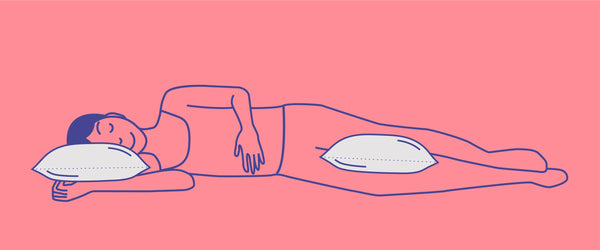
Have you ever needed to use two pillows to sleep, or put a pillow between your legs? That means you've been sleeping with the wrong pillow. It's not subjective, it's science. How you sleep says a l...

Sleep Positions
Have you ever needed to use two pillows to sleep, or put a pillow between your legs? That means you've been sleeping with the wrong pillow. It's not subjective, it's science. How you sleep says a lot about you – or more importantly, what your body needs for a good night’s rest.
TAKE OUR QUIZ to find your perfect pillow.
A whopping 74% of people are side sleepers
– imagine that! What’s important for them is to fill the gap between the shoulders and neck, as seen below. This means a firm pillow is necessary for better alignment, and comfort for sleeping.
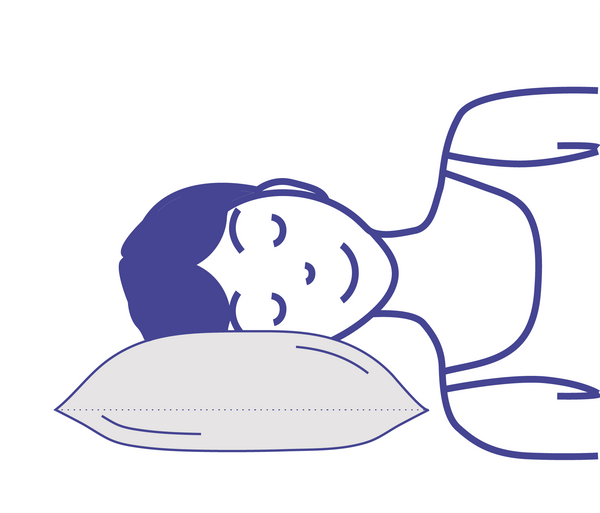
Next up are stomach sleepers, with 16% of people snoozing on their stomachs. Although doctors don’t recommend sleeping on your stomach, because of the undue strain it puts on your neck and back, they do recommend a soft pillow to align your spine, if you must.

Last but not least, 10% of people sleep on their back. Along with stomach sleepers, it’s also recommended that they use a soft pillow for proper spine alignment.

But no matter what pillow you get, it’s important to swap your pillow out every 1-2 years for optimal support for every snooze.
Now that we’ve talked about right pillows for sleep positions, are you ready to find yours?
TAKE OUR QUIZ to find your perfect pillow. Over 25,000 people have done so and upgraded their sleep. It is 100% science backed and takes <1 minute.
Ready to upgrade your sleep?
Take our 60-second sleep quiz and find your perfect setup.
Take the Sleep Quiz
How Does It Work?
It’s hard to find a good, quality pillow – one that makes you feel like you’re sleeping in a hotel, without the hotel price. We spent hours looking online, in Bed Bath Beyond and even Ikea, but cou...
How Does It Work?
It’s hard to find a good, quality pillow – one that makes you feel like you’re sleeping in a hotel, without the hotel price. We spent hours looking online, in Bed Bath Beyond and even Ikea, but could not find the right one. This is when we decided to start our own pillow company. So here’s the lowdown: hotels use specific manufacturers to make their pillows, and we tapped them to make ours, too.
With FluffCo pillows, you get the same hotel pillows you find in 5-Star hotels (the ones that charge you $500+ a night!). The ones with high thread count fabric, down and feather cores, and pillow protector – but at a fraction of the price. If you don’t believe us, we’ve got a trusty chart to convince you otherwise.

Our pillow has the soft, fluffy cushion and core support for the sweet dreams you’ve been, um, dreaming of. Plus, it’s even made of Tencel®, for the breathable, cool side of the pillow feeling every time you sleep.
Best of all, you can try our pillow for 30 days for a full refund – so you won’t lose a wink of sleep. Just think: the next time you want hotel quality-sleep, are you going for the pillow that broke the bank and made you lose sleep – or the one that helped you get it?

After all, there’s a reason we were voted Best Overall Pillow of 2021 by Apartment Therapy, Best Pillow of 2021 by Men’s Health, and racked up a ton of other awards. Don’t miss out on the pillow that’ll make you want to put your phone down before bed.

Ready to upgrade your sleep?
Take our 60-second sleep quiz and find your perfect setup.
Take the Sleep Quiz
The 'Hotel' Pillow
The premium hotel experience is always so refined: with A+ amenities, and extra soft pillows. The thing is, it’s always been hard to recreate that comfy experience at home. But, it's for a reason. ...

The 'Hotel' Pillow
The premium hotel experience is always so refined: with A+ amenities, and extra soft pillows. The thing is, it’s always been hard to recreate that comfy experience at home. But, it's for a reason.
The hotel industry has spent millions figuring out what the best pillow is for a good night’s rest, and they have it down to a science. The key is a soft, cushy outerpart, with a supportive cushion at its core. But why doesn't anyone know this? And why is it impossible to buy these pillows on the market for less than $150?

This is the bedding industry's best kept secret. Once we found this out, we got inspired to make our own, keeping up the high quality, but not fluffing up the price tag. It's how we made the Down & Feather pillow, which has the same hotel-like feel you're familiar with (and at a price you'll love).
The results? Our hotel pillow was voted Best Overall Pillow of 2021 by Apartment Therapy, Best Pillow of 2021 by Men's Health, and has racked up a ton of other awards.
Intrigued? TAKE OUR QUIZ to find your perfect pillow. Over 25,000 people have upgraded their sleep doing so. It is 100% science backed, and takes less than 1 minute.
So what are you waiting for? You can try risk-free with our 30-day free trial, so you truly won’t lose a wink of sleep.
Ready to upgrade your sleep?
Take our 60-second sleep quiz and find your perfect setup.
Take the Sleep Quiz
Hotel-Quality Pillows: A Buyer's Guide
When you lay your head down on a hotel pillow, you instantly recognize its quality. It’s fluffy but not too fluffy. It’s supportive but not too firm. It’s basically the Goldilocks of pillows.

Hotel-Quality Pillows: A Buyer's Guide
When you lay your head down on a hotel pillow, you instantly recognize its quality. It’s fluffy but not too fluffy. It’s supportive but not too firm. It’s basically the Goldilocks of pillows. But perfect pillows aren’t exclusively for nice hotels. The same manufacturers that supply hotels with their cloud-like pillows also sell directly to shoppers, so you can sleep like a pampered guest in the comfort of your own home.
In this article, we’ll walk you through everything you need to know about where to find hotel-quality pillows and how to shop for them.
- What Pillows Do Hotels Use?
- Where Do Hotels Get Their Pillows?
- How to Shop for Hotel Quality Pillows
Hotel-Quality Pillows - What You Need to Know
It’s easy to buy hotel-quality pillows yourself, but first you must know what to look for. Before we delve into your shopping options, we’ll answer some common questions shoppers have about finding the best pillows.
What Pillows do Hotels Use?
Hotels have high criteria when it comes to pillows. They must provide guests with a perfect night’s sleep, accommodate a range of pillow preferences, and maintain pillow fluffiness despite constant use. That’s a tall order, but there are two types that fit the bill: down, and feather and down alternative. These filler types provide the highest quality, comfort, and durability.
Hotels are also careful to select pillows with the perfect blend of fluffiness and support. They look for pillows with medium firmness that have a three- to five-inch loft, which is the height of the pillow when it’s compressed. This provides enough versatility to accommodate most guests.
What Are the Best Pillows Materials?
Down and feather pillows are generally considered to be the best option on the market. They provide the perfect level of fluff, resist wear and tear, offer excellent temperature regulation, and get more comfortable with use.
While down is considered the best of the best, down alternative is a close runner up. Down alternative is a blend of fibers that closely resemble the features of down. They provide a great balance of softness and support, and they’re very durable. They also have the added benefit of being hypoallergenic.
Where Do Hotels Get Their Pillows?
Hotel pillows may seem like they come from a magical land of pillow perfection that only hotels can access, but it’s not true. These pillows come from name-brand suppliers that also sell directly to the public, so you can have hotel-quality pillows, too.
Your favorite luxury hotel may offer pillows for sale on their website, but they purchase these from a supplier, brand them, and then sell them at a markup. You can find the same hotel-quality pillows for less directly from brands such as FluffCo.
Now that you know where to look for hotel-quality pillows, the next step is learning how to choose the best pillows for your home.
How to Shop for Hotel-Quality Pillows
All hotel-quality pillows will surpass any you’ll find at a big box store, but there are still essential nuances to consider when shopping for your new pillows. There are several different filler options, and each comes with its own characteristics. We’ll cover the most common fillers so you can find your dream pillows.
What Pillow Material Should I Choose?
The filler material is the most important component of a pillow. It dictates the pillow’s durability, cost, and feel. We’ve covered all the need-to-know info to help you choose your perfect hotel-quality pillow.
Down
Down is the ultra-soft undercoat from a goose or duck. Down is exceptional at regulating temperature, meaning you won’t constantly be flipping your pillow over in search of the cool side. While down from both geese and ducks is softer and better at regulating temperature than any other material, goose down is noticeably better in this area.
Pillows filled with down are the most durable option on the market. It’s not unusual for a down pillow to stay in great condition for several years if it’s maintained properly (they actually get softer and even more comfortable with age!). This durability offsets its price tag, which is often in the $65-$120 range for a single pillow. Compared to a $10 cotton-filled pillow that provides less comfort and will go flat in about six months, the down pillow is the smarter investment.
Down and Feather Combo
In addition to 100% down pillows, some hotels also use a combination of down and feather filling to create a more supportive pillow. This is an excellent option if you prefer a firmer pillow but still want the comfort and durability of down.
These hybrid pillows come in a wide variety of mixes, ranging from half down and half feathers to 5% down and 95% feathers. As a general rule, the more feather content in the pillow, the firmer it will be. A half-and-half ratio is most common for hotel use. This creates a very supportive pillow but still has a satisfying fluffiness.
Down Alternative
Down alternative fill provides the fluffy-yet-supportive comfort of down but with a less expensive price tag. It’s made with a special blend of synthetic fibers that’s designed to mimic the physical characteristics of down pillows.
While they are not quite as long-lasting as true down, they're much more durable than cotton fill. This pillow material is an excellent choice for vegans and allergy sufferers because it doesn’t use any animal products, and it still provides a luxurious hotel-pillow experience.
Cotton and Polyester Fill
If you’re not ready to invest in pricier pillows, cotton or polyester fill pillows are an inexpensive option that you can find at almost any big box store. These pillows come in a variety of styles, so you can easily find a pillow with your preferred firmness level. The downsides are that they aren’t hotel-quality, and they’ll likely need to be replaced within a year.
Find Your Perfect Hotel-Quality Pillow
Now that we’ve covered all the secrets about finding the best hotel pillows to buy, you can recreate the luxury hotel experience right in your own home. Review the filler options to choose the one that works best for you, then check out FluffCo’s selection of hotel-quality pillows to find your perfect match.
Ready to upgrade your sleep?
Take our 60-second sleep quiz and find your perfect setup.
Take the Sleep Quiz
How to Care for Your Down Pillows
Hotel-quality pillows help you drift off to dreamland quickly and sleep deeply. When you invest in your sleep by buying great pillows, you want to make sure they last. We’ll show you how to keep y...

How to Care for Your Down Pillows
Hotel-quality pillows help you drift off to dreamland quickly and sleep deeply. When you invest in your sleep by buying great pillows, you want to make sure they last. We’ll show you how to keep your new pillows clean and fluffy with the same level of care and attention that 5-star hotels use.
Down Pillow Maintenance Tips
Try these tips to keep your pillow in good condition between washes.
- Use a pillow protector. You can keep your pillow cleaner longer by using a pillow protector. A pillow protector is similar to a pillowcase, but it zips closed to fully protect the pillow. This goes on first, and then a pillowcase goes on top of that. Adding this additional protective layer prevents some of the dust, oil, and sweat from seeping into your pillow as you sleep. You will still need to launder your pillows, but they’ll be less soiled and the natural yellowing process will take longer.
- Wash pillowcases and protectors weekly. Treat them as you do your bed linens.
- Never go to bed with wet hair. This can lead to mildew, especially if your pillows are made from down.
- Fluff your pillow often. Gently pull your pillow in and out lengthwise and widthwise. This adds air into the pillow and helps maintain its loft. You can do this daily as part of your bed-making routine. This works for all pillows types except foam, which can’t be fluffed.
How Often Do You Need to Wash Pillows?
Over time, pillows collect sweat, body oils, skin cells, and dust mites. To keep them fresh and make them last longer, it’s important to wash them periodically. Washing your pillows every six months is a good rule of thumb. However, if you sweat a lot in your sleep, consider washing your pillows every three to four months.
How to Wash and Dry Down Pillows
The first step to washing a pillow — no matter what type it is — is to check the label. It may provide specific care instructions, such as dry clean only, that should be followed for best results.
For machine washable pillows, follow these steps:
- Take off the pillowcase and pillow protector (if using).
- Spot clean stains with a stain remover.
- Put the pillow in the washing machine. For top-loading washing machines, put pillows in vertically.
- Ensure the load is balanced by washing pillows in pairs.
- Wash the pillows with cold water on the gentle cycle using a mild detergent.
When washing pillows, it’s important to keep the size of your washer in mind. It’s generally a good idea to wash pillows in pairs to balance the load, but don’t force two pillows in if your washer is small. It’s more important to ensure your pillows have space to circulate in the wash. This ensures the detergent is properly distributed and keeps pillows from becoming misshapen.
How to Wash Down Pillows in a Front-Load Washer
Many down or feather pillows can be machine washed using the steps above. However, always check your pillow’s cleaning label first as some may be dry clean only.
If possible, always wash down and feather pillows in a front-load washer. This washer type doesn’t have a spindle in the center, allowing pillows to circulate easily without getting twisted or damaged.
Even if you have a front-loader at home, your down and feather pillows will benefit from a trip to the laundromat. Commercial washing machines are larger and give your pillows plenty of room during the wash cycle which allows them to hold their shape better.
Mild detergent, cold water, and a gentle wash cycle are especially important for down pillows to avoid damaging the delicate filling.
How to Wash Down Alternative Pillows
Most down alternative pillows can be machine washed using the steps above. Unless the pillow’s label indicates otherwise, it shouldn’t need any special modifications.
How to Wash Foam Pillows
Foam pillows must be hand washed. Putting them in the washing machine will break down the foam and ruin the pillow.
To hand-wash your foam pillow:
- Remove the pillowcase and protector.
- Vacuum the pillow to remove dust and debris.
- Fill a large sink with warm water and mix in a mild detergent.
- Put the pillow in the water and gently squeeze it to help the water and detergent seep in.
- Continue agitating the pillow for five to 10 minutes.
- Drain the sink and refill it with clean water.
- Rinse out the detergent by repeating the squeezing action in the clean water, draining and refilling the sink until it’s no longer sudsy.
- Gently press out excess water, and then allow the pillow to air dry.
The key to effectively hand washing your foam pillow without damaging it is to focus on squeezing gently. Never dig your fingers into the pillow or use a wringing motion, as this will tear the foam.
How to Dry Down Pillows
Thoroughly drying your pillow is essential to prevent mildew and odors. (Yes, it will take a while. Be patient!) If your pillow’s label doesn’t provide specific drying recommendations, you can use the steps below.
- Put the pillow in the dryer.
- Use a low-heat setting for synthetic fiber-filled pillows and a low- or no-heat setting for down or feather pillows. (If you need to use high heat to kill allergens such as dust mites, do so only for the first 20 minutes of drying time.)
- Time dryer cycles for about one hour.
- Check the pillow after each cycle. If it feels even a little damp, return it to the dryer for another cycle. Pillows made from synthetic fabrics typically dry within an hour to an hour and a half. Down and feather pillows take several hours.
Air drying is also a great option for all pillow types (and the only option for foam pillows). If the weather is sunny, you can air dry your pillows outside for extra freshness. Otherwise, air dry them inside in a room other than the bathroom or laundry room to avoid humidity, which can slow down the drying process.
Find Your Perfect Hotel-Quality Pillow
Purchasing a hotel-quality pillow is the first step toward better sleep. THe next step is maintaining that pillow so it lasts as long as possible. With proper washing and drying techniques, you can extend the life of your pillow and get countless nights of quality sleep.
Wondering where to buy hotel pillows? FluffCo can help you find the pillow of your dreams with our hotel-quality selections.Ready to upgrade your sleep?
Take our 60-second sleep quiz and find your perfect setup.
Take the Sleep Quiz
How to Care for Your Down Comforter
A fluffy, warm, hotel-quality comforter can make going to bed the highlight of your day. To keep your comforter in tip-top shape, it’s important to care for it properly. In this article, we’ll teac...
How to Care for Your Down Comforter
A fluffy, warm, hotel-quality comforter can make going to bed the highlight of your day. To keep your comforter in tip-top shape, it’s important to care for it properly. In this article, we’ll teach you how to wash, dry, and maintain your comforter so you can continue getting quality Zzzs for years to come.
Down Comforter Maintenance Tips
Let’s be honest — no one looks forward to washing a comforter. It’s bulky, takes ages to dry, and might not even fit in your home washing machine. The longer you can go between washes, the happier you’ll be and the longer your comforter will last. Use the tips below to keep your comforter as clean as possible between washes.
- Use a duvet cover. A duvet cover goes over your comforter (also called a duvet) the same way a pillowcase goes over a pillow. It’s your first line of defense against dirt, sweat, and stains, and it can greatly extend the life of your comforter. Treat your duvet cover like the rest of your bed linens and wash it about once a week.
- Avoid eating and drinking in bed. This keeps your comforter cleaner longer and ensures you never have to worry about food and drink stains.
- Keep pets off the bed. We’re not passing judgment if you just can’t resist those puppy dog eyes or if your pet has stubbornly claimed your bed as their own. However, if you can keep pets off the bed, your comforter will stay much cleaner.
- Vacuum and deodorize your comforter about twice a year. Remove the duvet cover, sprinkle baking soda over the comforter, let it sit for a few hours, and then vacuum it off with a brush attachment.
How to Wash a Down Alternative Comforter
Washing a comforter can be intimidating because of its size, but it doesn’t have to be complicated. Before you begin, check the label to see if there are any special cleaning instructions. Some comforters may be dry clean only, in which case you shouldn’t try washing them at home.
- Remove the duvet cover, if you’re using one.
- Spot clean any stains with your preferred stain remover.
- Put the comforter in the washing machine. (If you have to stuff it in there, your machine is too small and you should take it to a laundromat instead. Otherwise, the water and detergent won’t circulate properly and your comforter won’t get clean.)
- Wash on the gentle cycle using cold or warm water. Hot water can damage delicate comforter fillings.
- When the wash cycle finishes, put it through another round without detergent to help rinse out all the soap residue. Do this process again, but take the comforter out and rearrange it before putting it back into the washer. This ensures all areas of the comforter get exposed to the rinse cycle.
How to Dry a Down Alternative Comforter
Comforters are heavy when wet, so hanging them up to air dry isn’t usually an option. Instead, use your dryer and follow these steps:
- Load the comforter into the dryer.
- To speed up the drying process, some people swear by the towel trick. If you have enough extra space in your dryer, add two or three dry towels in with the comforter to absorb extra moisture.
- Run the dryer on low to medium heat. (To dry down comforters, use low heat only.)
- Remove the comforter every 30 minutes or so during the drying cycle. Redistribute the filling evenly throughout the blanket, and rearrange the comforter before putting it back in the dryer so that all areas get fully dry. You will likely need to go through many drying cycles (about 2+ hours) to get the comforter completely dry.
How to Wash and Dry a Down Comforter
Washing a down comforter is trickier than washing those made from down alternative or other materials. Down is delicate and expensive, so there’s a lot at stake here. In most cases, the best option is to take it to a professional cleaning service that specializes in down comforters. Professional services may be a little pricey, but if you practice good habits such as using a duvet cover and not eating in bed, you should only need to wash your comforter once every year or two.
That said, if you can’t take your comforter to a professional cleaner, you can use the same washing steps listed above with a few adjustments:
- Never wash a down comforter in a top-loading washer. It may get twisted up in the spindle and damaged.
- Whenever possible, use a commercial washing machine rather than your home washer. The extra space will help the comforter circulate more gently in the wash.
- The two extra rinse cycles outlined in the washing steps above are especially important for down comforters because detergent residue can flatten the down’s loft. Don’t be tempted to skip that step to save time.
- Take your down comforter out of the dryer every 30 minutes and fluff it up. Make sure to redistribute the down evenly throughout. This will help retain its loft.
- Shopping tip: When buying a down comforter, look for one with stitched squares called baffle boxes. These help keep the down in place, make it easier to wash, and keep it soft and fluffy longer.)
How Long Do Comforters Last?
A good down or down alternative comforter can last 10 years or more if it's cared for properly.
Here are signs that it’s time to replace your comforter:
- The filling is bare in some areas and lumpy in others.
- It’s heavily stained.
- It has mildew or smells bad even after washing.
- It no longer has that luxurious, comforting feel that it used to.
Find Your Perfect Hotel-Quality Comforter
You’re now armed with everything you need to know to keep your perfect comforter soft, fluffy, and clean. If you’re still searching for a comforter so good you never want to get out of bed, check out FluffCo’s hotel-quality comforters.
Ready to upgrade your sleep?
Take our 60-second sleep quiz and find your perfect setup.
Take the Sleep Quiz
Hotel-Quality Bath Towels: A Buyers Guide
Stepping out of the shower and wrapping yourself up in a fluffy, luxuriously oversized towel is one of life’s small pleasures. It’s an experience you may only have had while at a luxe spa or hotel,...
Hotel-Quality Bath Towels: A Buyers Guide
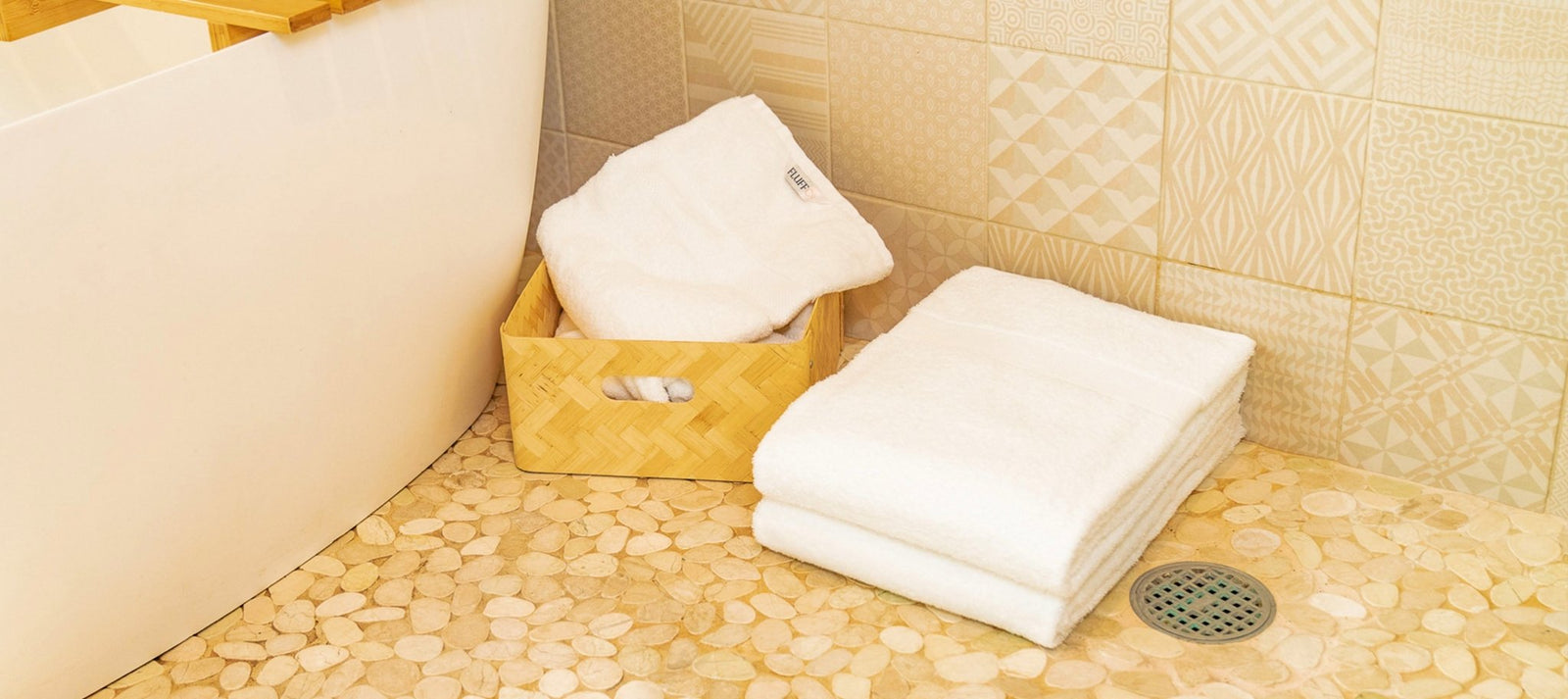
Stepping out of the shower and wrapping yourself up in a fluffy, luxuriously oversized towel is one of life’s small pleasures. It’s an experience you may only have had while at a luxe spa or hotel, but it’s easy to get that pampered feeling in your own home. Our guide to hotel-quality bath towels will teach you everything you need to know to find high-quality towels for your home.
What are the Best Materials for Hotel-Quality Bath Towels?
Material is an essential factor to consider when choosing upscale towels. There are several options available, and your choice will depend on your personal preferences. To help you narrow down the possibilities, we’ll highlight the key features of these towel materials:
- Turkish cotton
- Egyptian cotton
- Traditional cotton
- Microfiber
Classic Cotton
There’s a reason 100% cotton towels have become an enduring classic for luxe hotels. They’re incredibly soft, absorbent, and durable — all in one easy-to-care-for package. Upscale hotels that pamper guests with classic cotton towels make sure to select ones with a heavy weight, or high GSM. (Don’t worry; we’ll dive into the ins and outs of GSM in the next section!) They provide the comfort and indulgence guests expect while often being more affordable than Turkish or Egyptian cotton towels.
Turkish Cotton
This long-fiber cotton is grown only in a single region of Turkey. The unique climate of the Aegean region produces cotton with fibers that are longer, smoother, and more durable than those of regular cotton.
Turkish cotton towels differ from the typical thick and fuzzy bath towel. Though they typically have a high GSM, the towel is thin and smooth. The slim profile and silky feel are due to a flat weave, which helps Turkish cotton dry more quickly than Egyptian or other cottons. This material is also extremely durable, and your Turkish cotton towels will actually become softer and more absorbent with use.
Egyptian Cotton
Egyptian cotton has extra-long fibers that combine the thinness and durability of Turkish cotton with the fuzzy absorbency of regular cotton. This makes for a luxuriously soft material capable of quickly drying up any post-shower drips.
Though this material is highly absorbent with a lush look and feel, it does have one drawback. Egyptian cotton towels stubbornly hold onto moisture if they aren’t properly dried after use. In an arid climate, this isn’t an issue. You can simply hang the towel and allow it to air dry between uses.
However, if you live in a very humid area, the towels will stay wet if you just hang them up. Egyptian cotton is so absorbent that it can actually pull moisture from the air, which can cause issues with mildew. If you live in a humid environment but love the lush feel of Egyptian cotton, you can circumvent this problem by tossing your towels in the dryer between uses.
Microfiber
Microfiber is a synthetic fiber, often made from polyester or nylon, that mimics the slender smoothness of Turkish and Egyptian cottons. These fibers can create strands several times thinner than a human hair, giving them astonishing absorbency relative to their weight and thickness.
Unlike the Egyptian cotton it mimics, microfiber is both super absorbent and quick-drying, meaning you’ll never have to worry about mildew or odors. This high-tech fabric is a great choice if you love the slim profile and deluxe feel of Egyptian cotton but want a low-maintenance towel.
Hotel-Quality Towel Weights
Much like thread count in bed sheets, towel weight is a key indicator of quality. Towel weight is measured in grams per square meter, or GSM. The higher the GSM, the heavier the towel. A towel with a high GSM is thicker, softer, and more absorbent than a lighter one of the same material.
Let’s put GSM into context to help you get a better understanding of how it translates to quality.
-
Light, 300-400 GSM: Towels in this range tend to be thin, a little scratchy, and somewhat see-through, but they dry quickly and are inexpensive. You often see towels in this range used at places like gyms and hospitals.
-
Medium, 500-600 GSM: Most standard bath towels fall into the medium weight category. They are thicker and more absorbent than lighter weight towels, but they fall a little short of that royalty-level lavishness you get with five-star hotel towels.
- Heavy, 700+: Towels with GSM of 700 or more are the type you expect to see at a high-end spa or hotel. They seem to dry you off instantly, thanks to their high absorbency. Towels in this range are noticeably softer and more luxurious than their light and medium weight counterparts. Our towels are 1,100 GSM, which is far above market standards for the most luxurious feel.
What is the Best Size for Hotel-Quality Bath Towels?
When you’re looking for upscale bath towels, you want to choose ones that are oversized. There’s nothing luxurious about stepping out of the bath and into a slightly too-small towel, no matter what weight or material it is!
Bath towels purchased for home use are typically about 30” x 56.” This size is adequate, but to get that five-star-hotel feel, choose towels that are closer to 35″ x 66″ (like our hotel quality towels). That’s the perfect size to comfortably wrap yourself up in and replicate an upscale spa experience in your own home.
Find Fluffy Hotel-Quality Towels at FluffCo!
FluffCo. is on a mission to bring the five-star hotel experience to your home at a price that makes sense. Our custom-created towels are made by the same factories that make upscale products for five-star hotels. Made from 100% cotton with a GSM of 1,100, our hotel-quality bath towels are perfectly plush and oversized to add a touch of luxury and comfort to your everyday life. Find your perfect hotel quality towel today!Ready to upgrade your sleep?
Take our 60-second sleep quiz and find your perfect setup.
Take the Sleep Quiz
Hotel-Quality Bath Robes: A Buyers Guide
Five-star hotels are renowned for their luxurious bath robes. Those ultra-soft and cozy robes are a delight to slip into after a long day of travel, and you can capture that same “ahh” moment at ho...
Hotel-Quality Bath Robes: A Buyers Guide
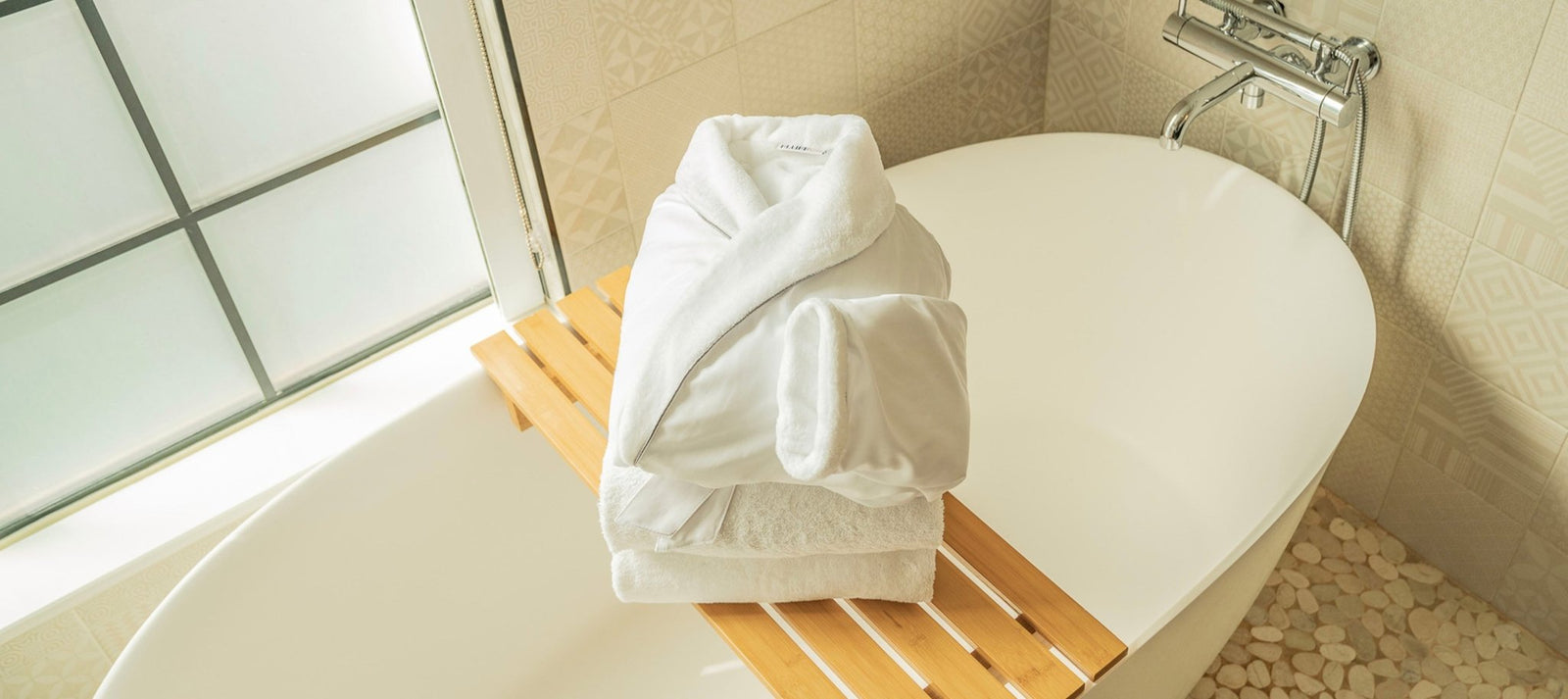
Five-star hotels are renowned for their luxurious bath robes. Those ultra-soft and cozy robes are a delight to slip into after a long day of travel, and you can capture that same “ahh” moment at home, too.
We’ll guide you through the ins and outs of hotel-quality robes so you can find the perfect one to add a touch of luxe to your everyday life.
Which Type of Hotel Robe Should I Get?
You have several options when it comes to hotel-quality robes. The most important factors to consider are material and length.
The best material will be the one that suits the way you plan to use your robe. Want to step out of the shower and straight into your robe? Choose an absorbent material such as microfiber or cotton. Prefer something warm and cozy? Go for a fleece option.
Read on to learn more about each type of material and see the most common length options.
Hotel Robe Material - How to Choose Material for Your Hotel-Quality Robe
There are a few go-to materials that five-star hotels and spas choose for their robes. We’ll help you find the perfect material for your luxury robe by covering the characteristics of these options:
- Microfiber
- Cotton
- Fleece
- Terry cloth
- Waffle knit
Microfiber
Microfiber is a lightweight, breathable material that can mimic the luxurious qualities of other fabrics, such as cotton or silk, while eliminating their drawbacks. With fibers that are less than half the size of a single human hair, microfiber offers high absorbency while maintaining a light, comfortable weight.
Microfibers are extremely durable and resist stains as well as mold and mildew. Their durability, low maintenance, and incredible softness make microfiber robes a popular choice for five-star hotels and a great option for bringing high-end comfort to your everyday life.
Cotton
There’s a wide variety of cotton robe options, including cotton blends, but upscale hotels typically choose 100% classic, Egyptian, or Turkish cotton for the most luxurious experience. Classic and Turkish cotton are ultra-absorbent but dry quickly, making them the perfect material for those who like to slip on a robe right after a relaxing bath. Egyptian cotton is also absorbent, but its incredible softness is a trade off for a slower drying time.
Fleece
Fleece is a particular style of polyester knit that provides the comforting softness of wool without the weight or hefty price tag. Coral and polar are the two most common types of fleece, but high-end hotels tend to use coral fleece for their robes because it’s fluffier and feels more indulgent. Fleece is the perfect option if you want a robe that’s warm, fast drying, and incredibly soft.
Shop our luxury coral fleece lined robes here.
Terry Cloth
Despite having “cloth” in its name, terry cloth is a type of weave rather than a fabric. We’ve included it here because shoppers often think of it as a material, and we want to provide a comprehensive look at your options for hotel-quality robes.
Terry cloth is most often made from cotton fabric, though it can also be made from other materials such as linen or polyester. Most hotels and spas choose cotton for their terry cloth fabric. The special weave that creates terry cloth increases the surface area of the fabric, making terry cloth robes extremely absorbent and soft.
Waffle Knit
As with terry cloth, waffle knit is a particular type of weave rather than a fabric, and it’s typically made from cotton or microfiber. A waffle knit weave creates a raised texture that’s typically in a pattern of either squares (waffle) or diamonds (honeycomb).
Waffle knit fabrics are often called thermals because they provide exceptional warmth thanks to the raised pattern of the weave trapping air close to the body. As a trade off for warmth and coziness, waffle knit robes aren’t quite as soft to the touch as those with a standard or terry cloth weave.
How to Choose Length for Your Hotel-Quality Robe
High-end hotel robes come in three lengths: above-the-knee, mid-calf, and ankle-length. Unlike with materials, robe length doesn’t affect quality. The best length will depend on your personal style preferences and the climate where you live.
-
Above-the-knee: This is the shortest robe option, hitting an inch or two above the knee. This length allows for the most maneuverability since your legs are uncovered. It’s a great choice for those days when you want to be cozy, but it’s too warm to be completely covered up.
-
Mid-calf: This is the goldilocks of robe lengths — not too long, not too short. It’s the perfect length for all but the hottest weather, and it’s a great choice for those who prefer a more modest length.
- Ankle-length: An ankle-length robe is the longest robe length and extends down to the ankle. Since it covers you from shoulder to ankle, it’s the warmest option and is great for cooler climates. Equally as important, it just feels indulgent to be fully wrapped up in an ultra-luxurious bath robe!
It’s important to note that these lengths are all relative to your height. For instance, an above-the-knee robe might be calf-length for you if you're on the shorter side. If you’re tall, mid-calf might mean above-the-knee.
To ensure you get the fit you’re looking for, measure from your shoulder down to where you want the robe to extend. As you’re shopping, check the robe’s length against the measurement you took to get an accurate idea of how the robe will fit you.
Find the Right Hotel Robe for You at FluffCo!
Luxury experiences shouldn’t be confined to five-star hotels. At FluffCo, our mission is to bring the royalty treatment right to your home with upscale, hotel-quality robes. Our deluxe bath robes have a plush microfiber cotton exterior, an inner lining of cozy coral fleece, and elegant gray piping. They’re perfect for anyone who appreciates comfort and style. Ready to wrap yourself up in a cloud-like robe and relax? Order your luxury bath robe today!Ready to upgrade your sleep?
Take our 60-second sleep quiz and find your perfect setup.
Take the Sleep Quiz
The Best Pillow for Side Sleepers in 2026, and How to Stop Waking Up Sore
The best pillow for side sleepers is one that's firm and high enough to fill the gap between your ear and the outside of your shoulder, so your neck stays in a straight line with your spine. Too lo...
The Best Pillow for Side Sleepers in 2026, and How to Stop Waking Up Sore
Written by the FluffCo team. We have made hotel-style pillows since 2020 and sold over a million. Every pick here is checked against what side sleepers report on Amazon, Reddit, and Trustpilot, including the latest from 2026.
You sleep on your side, and you wake up with a crushed shoulder, a numb arm, or an ear that got folded forward all night. Sound familiar?
Most side-sleeper pain comes down to one thing: the pillow is the wrong height. After a million pillows sold, we know a review only counts when it's real. So we checked every pick here against what side sleepers report on Amazon, Reddit, and Trustpilot.
Below is the best pillow for side sleepers for 2026: how high and firm it should be, which picks fit which sleeper, and how to stop waking up sore.

TL;DR
The best pillow for side sleepers is firm and high enough to fill the gap between your ear and the outside of your shoulder, so your neck stays in a straight line with your spine.
- The best plush pick for side sleepers is the FluffCo Firm Fluff, feather-free with a higher fixed loft, at $69.
- The best adjustable pick is Coop, since you add or remove fill to hit your exact height.
- The best pick for neck and shoulder pain is the Saatva Latex Pillow in High Loft, whose springy latex core and gusset hold your head up, at $165.
- The best firm value pick is the Brooklyn Bedding Talalay Latex Pillow, a solid latex block that holds its shape, at $89.
- The best pick for hot sleepers is the Layla Kapok Pillow, adjustable and cooling, at $109.
- Before you buy, measure the gap from your ear to the edge of your shoulder. Your pillow should fill it and stay firm, not collapse.
Not sure which pillow is yours?
The fill is the easy part. How you sleep is what actually decides the pillow. The Sleep Concierge sorts that, plus firmness and temperature, then names one. Two minutes.
The best pillows for side sleepers in 2026, compared
| Pillow | Fill and build | Loft and Firmness | Best for side sleepers | Price | Where to buy |
|---|---|---|---|---|---|
| FluffCo Firm Fluff | Microfiber down alternative, 300TC cotton shell | Firm Fluff, higher fixed loft | Plush pick with a higher fixed loft | $69 | Amazon or fluff.co |
| Coop Original | Adjustable shredded memory foam | You set the loft | Dialing in your exact height | Around $70 to $100 | Amazon or direct |
| Saatva Latex, High Loft | Shredded Talalay latex core, down-alt wrap | Medium soft, 6 to 7 inch high loft | Neck and shoulder pain | $165 queen | Saatva.com |
| Brooklyn Bedding Talalay, High Loft | Solid ventilated Talalay latex block | Medium firm, 5 inch high loft | Firm support and value | $89 queen | Brooklyn Bedding |
| Layla Kapok | Shredded memory foam and kapok | Adjustable, overstuffed to about 7 inches | Hot sleepers who want to shape it | $109 queen | Amazon or Layla |
Best pillow for side sleepers: FluffCo Firm Fluff
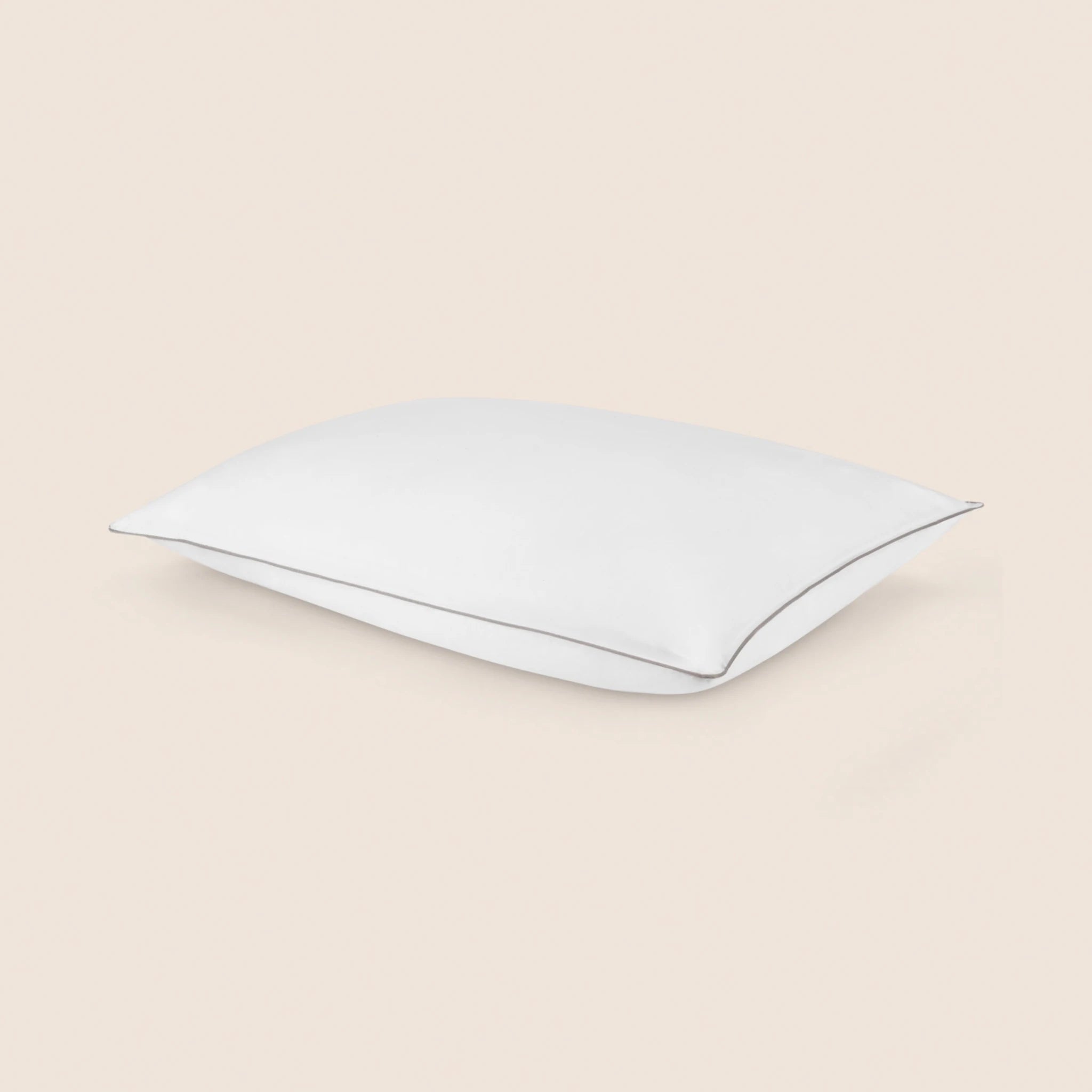
If you sleep on your side and want a plush pillow that still holds a higher loft, the FluffCo Firm Fluff is the one to buy. It's the firmer of our two down alternatives, so it fills the gap between your ear and shoulder without collapsing by 2am.
The FluffCo Down Alternative Pillow in Firm Fluff has a 300 thread count cotton shell and a microfiber fill, and it's made in the USA. It's a down alternative, so there are no feathers to poke your ear or fold against your face. The Cut includes the FluffCo Down Alternative in its best-pillows roundup, and you can read more on our press page.
When to buy FluffCo Firm Fluff
- If you side sleep and want a plush, higher-loft pillow that doesn't go flat under your head.
- If feathers poking your ear or cheek have been the problem. This is a feather-free down alternative.
- If you want a plush, feather-free pick without paying premium-down prices.
- If you're a side and back sleeper and want one pillow that works for both.
- If you'd rather grab it on Amazon with quick shipping than order direct.
When to skip FluffCo Firm Fluff
- If you need to fine-tune your height down to the inch. This is a fixed loft, so look at Coop or a trimmable latex pillow instead.
- If you run hot and want the coolest option here. Some sleepers say it warms up after a while.
- If your shoulders are very broad and you need an extra-tall pillow, check that the Firm Fluff loft is high enough for your gap first.
Here's what verified Amazon buyers say about the FluffCo Down Alternative:
Keeps a side sleeper's neck lined up
“keeps my neck aligned”
Amazon Customer, verified Amazon buyer, February 2026
Support through the shoulder
“neck support that extends to the shoulders”
LB, verified Amazon buyer, June 2025
No feathers digging in
“it doesn't hemorrhage feathers like other pillows”
Ann P, verified Amazon buyer, March 2025
The FluffCo Firm Fluff is $69.
Best adjustable pillow for side sleepers: Coop
If your shoulders are broad or no pillow is ever quite the right height, Coop is the one to try, because you set the loft yourself. It's an adjustable shredded-fill pillow, and it's the move a lot of side sleepers land on.
Unzip it, add or take out fill until your ear-to-shoulder gap is filled and your neck sits level, then zip it back up. It comes in a cutout and a crescent shape that side sleepers use to keep the shoulder from getting crushed.
When to buy Coop
- If you want to set your own loft by adding or taking out fill until your neck sits level.
- If you have broad shoulders and keep buying pillows that are too short.
- If you wake up with a stiff neck and want to tune the height out of it.
- If you want a side-sleeper shape, like the cutout or the crescent.
- If you want to unzip the cover and wash it.
When to skip Coop
- If you don't want to fuss with fill or fluff it up before bed.
- If a built-in angle bugs you. One side sleeper found the shape gave them neck pain and moved the fill into a flatter shell.
- If a strong chemical smell would put you off. A lot of owners say you have to air these out for a few days first, and one said the off-gassing gave them a headache.
On Amazon, a side and stomach sleeper named gaby gave it five stars in July 2026 and said it "keeps my neck properly aligned." Price: around $70 to $100 depending on the model.
Best pillow for side sleepers with neck and shoulder pain: Saatva Latex
If side sleeping leaves you with a stiff neck or a sore shoulder, the Saatva Latex Pillow in High Loft is the one to try. The shredded Talalay latex core gives a springy pushback that holds your head up instead of letting it sink, and a gusseted edge keeps that loft from flattening overnight.
The Saatva Latex Pillow wraps that core in a soft microdenier down-alternative layer, under an organic cotton sateen cover. Side sleepers want the High Loft, 6 to 7 inches, to fill the shoulder gap, and the inner latex core lifts out if you need to lower the height. A queen is $165 (Saatva, July 2026), with a 45-night trial and a 1-year warranty.
When to buy Saatva Latex
- If you get neck spasms or shoulder pain and want a latex core that pushes back instead of sinking.
- If you want the loft to hold all night. The gusseted edge helps it keep its height.
- If you like a two-in-one pillow. The latex core lifts out to lower the loft.
- If you sleep hot. The shredded latex and cotton cover stay cool for most owners.
- If broad shoulders leave a big gap and you want the taller High Loft.
When to skip Saatva Latex
- If a firm pillow crushes your ear. Some side sleepers find the shredded latex too hard against the face.
- If you don't want to re-fluff. The soft outer layer can compress and feel lumpy over time.
- If you want it light. Owners say it's heavy and awkward to flip at night.
- If the price is a stretch. At $165 it's the most expensive pick here.
- If you're petite or lighter. The High Loft can sit too tall, so start with the Standard.
On Amazon, a side sleeper with an injured shoulder said the height "stabilizes my neck and shoulders perfectly" and called it firm but giving (Erin Allen, verified Amazon buyer, September 2025). The Saatva Latex Pillow is $165 for a queen. Get the High Loft for side sleeping.
Best firm value pillow for side sleepers: Brooklyn Bedding Talalay
If you want firm latex support that holds its shape without costing a fortune, the Brooklyn Bedding Talalay Latex Pillow is the value pick. It's a solid ventilated block of Talalay latex, so it springs back the moment you lift your head and never needs fluffing.
Side sleepers want the High Loft at 5 inches, which levels your head over the downward shoulder. The cover comes in organic cotton or TENCEL, both of which sleep cool. A queen is $89 (Brooklyn Bedding, July 2026), with a 30-night trial and a 3-year warranty, which is low for real Talalay latex.
When to buy Brooklyn Bedding Talalay
- If you want firm, springy support that holds its height instead of sinking like memory foam.
- If you hate fluffing. The solid latex block resets on its own.
- If you sleep hot. The ventilation holes and the cotton or TENCEL cover pull heat away.
- If you want latex without the premium price. At $89 it undercuts most latex pillows.
- If you like a dense pillow to hug, which keeps your top shoulder from rolling forward.
When to skip Brooklyn Bedding Talalay
- If you have a narrower shoulder gap. Some side sleepers find the 5-inch loft too tall and wake with neck pain.
- If firm bounce bothers you. A few owners feel like they're fighting the pushback.
- If a new-pillow chemical smell puts you off. It needs a day or two to air out.
- If you want guaranteed all-natural latex. Buyers note the blend leans synthetic.
- If you might return it. A few owners report slow return labels and customer service.
On Amazon, a side sleeper said her "ear is happy, and doesn't feel smushed" on it, crediting the even firmness (Dana, verified Amazon buyer, June 2016). The Brooklyn Bedding Talalay Latex Pillow is $89 for a queen. Choose the High Loft.
What Are the Best Hotel Pillows to Buy?
The best hotel pillows to buy come in two fills, and FluffCo makes both. The Down Alternative gives you the hotel feel without feathers, vegan microfiber, made in the USA, machine washable. The Down Feather gives you the plush sink of real down. Not sure which? The concierge sorts it in two minutes.
Best pillow for hot side sleepers: Layla Kapok
If you run hot and want a pillow you can shape to your shoulder, the Layla Kapok Pillow is the adjustable cooling pick. It mixes shredded memory foam with soft kapok fibers, and the copper-infused cover vents heat for most owners.
It arrives overstuffed at around 7 inches, so you pull out fill until your neck sits level, then mold a small divot for your shoulder. A queen is $109 (Layla, July 2026), with a 120-night trial and a 5-year warranty, the longest testing window here.
When to buy Layla Kapok
- If you sleep hot and want the copper cover and kapok fibers to vent heat.
- If your shoulders are broad. It comes overstuffed, so there's plenty of fill to start.
- If you want to shape the pillow. The fill molds into a divot for your shoulder or arm.
- If you want a long trial. Layla gives you 120 nights to dial it in.
- If down-like softness matters. Buyers say it feels closer to real down than plain foam.
When to skip Layla Kapok
- If you want it right on night one. Getting the fill amount right takes a few nights.
- If mess bothers you. Removing fill is fiddly, and the pieces can shift and clump.
- If a new-foam smell puts you off. It off-gasses for a day or two out of the bag.
- If you sleep heavy on it. A few owners say it flattens and needs re-fluffing each morning.
- If cooling is the whole reason you're buying. Some find it no cooler than a normal pillow.
On Amazon, a self-described side sleeper who tested five pillows for neck pain kept this one because it "felt more pillow like" (SaidWhatWhen, verified Amazon buyer, May 2025). The Layla Kapok Pillow is $109 for a queen.

Expert tips for choosing the best pillow for side sleepers
Choosing the best pillow for side sleepers comes down to loft first, then a few fixes for your neck, shoulder, and arm. Here are the tips that matter most.
IF you sleep on your side or your back, go Firm Fluff for the height. The FluffCo Down Alternative comes in Soft Fluff or Firm Fluff, and the firmer one is the one that holds the loft under a shoulder.
1. Go firm, but not rock-hard, so the pillow holds loft without crushing your ear
Side sleepers need a firmer, higher pillow than back or stomach sleepers, because there's a wider gap to fill between your ear and the mattress. A soft pillow collapses under the weight of your head and lets your neck bend down toward the shoulder all night.
But firmer does not mean rock-hard:
- Too soft, and your head sinks through and your neck bends toward the shoulder all night.
- Too firm, and the pillow presses into your ear cartilage and folds it forward, what people call "pillow ear." One side sleeper woke up with sore temples for a month from clenching their jaw against a too-firm pillow.
- Just right is firm enough to hold its loft, with a little give so your ear sinks in instead of getting crushed.
That balance, firm but not hard, is the whole game for side sleeping.
2. Match the loft to your ear-to-shoulder gap so your neck stays level

A side sleeper's pillow should be high enough to keep your head, neck, and spine in one straight line, what side sleepers call the horizon line. If your neck bends up or dips down, the pillow is working against you.
Here are three ways to find your loft:
- Measure the gap. Measure from the side of your head to the outside of your shoulder, then pick a pillow that thick or a touch thicker, since your head sinks in a little.
- Stack of books. Lie in your normal side position and slide books under your head, adding and removing until your neck feels level. That stack is your target height.
- Take a photo from the side. If your neck is not a straight line with your spine, adjust the loft up or down.
Watch the extremes. Too high pushes your head up and drives weight down into the bottom shoulder for hours, which turns into a deep ache. Too low tilts your head toward the mattress and strains the neck. Broad shoulders almost always need more loft than people expect.
3. Choose a fill that holds a firm, stable loft instead of sinking flat
The best filling for side sleepers is one that holds a firm, stable loft all night, so it keeps filling the shoulder gap instead of sinking. How firm a fill feels changes a lot by material.
- Memory foam. Solid foam holds a consistent shape and supports well, but it can feel like a hard block and run warm. Shredded foam is more movable.
- Adjustable shredded fill. You add or remove it to hit your exact loft, which is why side sleepers reach for it. Coop is the common pick.
- Latex. Springy and firm, it holds its height, and a solid latex pillow can be trimmed down with a knife if it's too tall.
- Buckwheat. Moldable and firm, it holds whatever shape you press into it, so you can even make a small divot for your ear.
- Down and down alternative. Plush and cool, but it has to be firm and high enough not to collapse. The FluffCo Firm Fluff is the down alternative built for that, with a higher loft than the soft version.
If you already own an adjustable or overstuffed pillow that's too firm, try taking some fill out before you buy anything. A pillow that's too full puts constant pressure on your ear and the side of your face.
4. Add a knee pillow and hug a pillow to unload your sore shoulder

For side-sleeper shoulder and neck pain, get the loft right first, then take the weight off the shoulder you sleep on. The pillow under your head is only half the fix.
- Add a knee pillow. One pillow between your knees keeps your hips level and stops your spine twisting, which takes strain off your lower back and shoulder.
- Hug a pillow. Holding a firm pillow against your chest keeps your top shoulder from rolling forward and collapsing inward.
- Unweight the bottom shoulder. Some side sleepers build a channel with a torso pillow so the bottom shoulder drops into a gap instead of carrying the load.
One more thing worth knowing: a numb arm is often the neck, not the arm. A physical therapist told one poster's brother to stop stacking two flat pillows and switch to a single firmer one, and the morning arm tingling cleared up in a week. If your loft is wrong, your neck angle pinches the nerves that run down your arm.
5. Match loft to your shoulders, then fix what throws off your neck angle
To pick the right side-sleeper pillow, match the loft to your shoulder width and the firmness to how much you sink, then fix the small stuff that throws off your neck angle.
- If you have broad shoulders, go higher and firmer to fill the bigger gap.
- If you get ear pain, drop the firmness a little or loosen things up. A pillowcase a size too big, or a looser fill, takes pressure off the ear.
- If your arm goes numb, check the loft before you blame the arm. It's usually the neck angle.
- If you roll a lot, a satin pillowcase cuts the friction that yanks your shoulder around when you turn over.
- If your mattress is old and soft, it drops your shoulder and changes your neck angle even when the pillow is fine.
Chiropractors and doctors tend to point side sleepers to the same idea: a pillow that keeps the head, neck, and spine in one straight line, with steady support that doesn't collapse once you relax. The pillow a given tester or magazine rates best changes from year to year, but that neutral-alignment principle stays the same.
Once you know your loft, the same rules carry over to picking a great everyday pillow, which we cover in our guide to the best hotel pillows.
6. Spend on the right loft, not on a brand name
You don't need an expensive pillow to sleep well on your side. The right loft matters far more than the price on the tag.
- A $69 FluffCo Firm Fluff or an $89 Brooklyn Bedding latex can beat a $165 premium pillow if the height fits your shoulder gap.
- Plenty of side sleepers swear by a $0 rolled bath towel under the neck or a bag of buckwheat.
- Adjustable pillows that let you tune the fill can be worth a little more, since a side sleeper who can dial in the loft is halfway to fixing the pain.
Spend where it buys you the right height and steady support, not where it just buys a brand name.
Finding the best pillow for side sleepers in 2026 without the guesswork
In 2026, the best pillow for side sleepers still comes down to loft. Get the height right so your neck stays level, keep it firm enough that it doesn't collapse, and add a knee pillow to hold your hips in line.
If you want a plush, feather-free pick with a loft built for the shoulder gap, the FluffCo Firm Fluff is built for exactly that. You can shop the FluffCo Firm Fluff and pair it with a knee pillow for the full setup.
FAQs
Neither is better for side sleepers. What matters is a firm, high loft that keeps your neck level. Memory foam holds a consistent shape and supports well but can feel dense and run warm, while down and down alternative feel plusher and cooler but have to be firm and high enough not to collapse. For most side sleepers, a firm down alternative or an adjustable shredded fill hits the balance.
Yes, a side sleeper should use a pillow, and usually a fairly high one. Side sleeping leaves the widest gap between your head and the mattress, so going without lets your head drop and bends your neck sideways all night. A firm pillow that fills the shoulder gap keeps your neck in a straight line.
No, side sleepers should not have a flat pillow. A flat pillow lets your head tilt down toward the mattress, which strains the neck and drives weight into the bottom shoulder. Side sleepers need enough loft to keep the neck level with the spine.
Ready to upgrade your sleep?
Take our 60-second sleep quiz and find your perfect setup.
Take the Sleep Quiz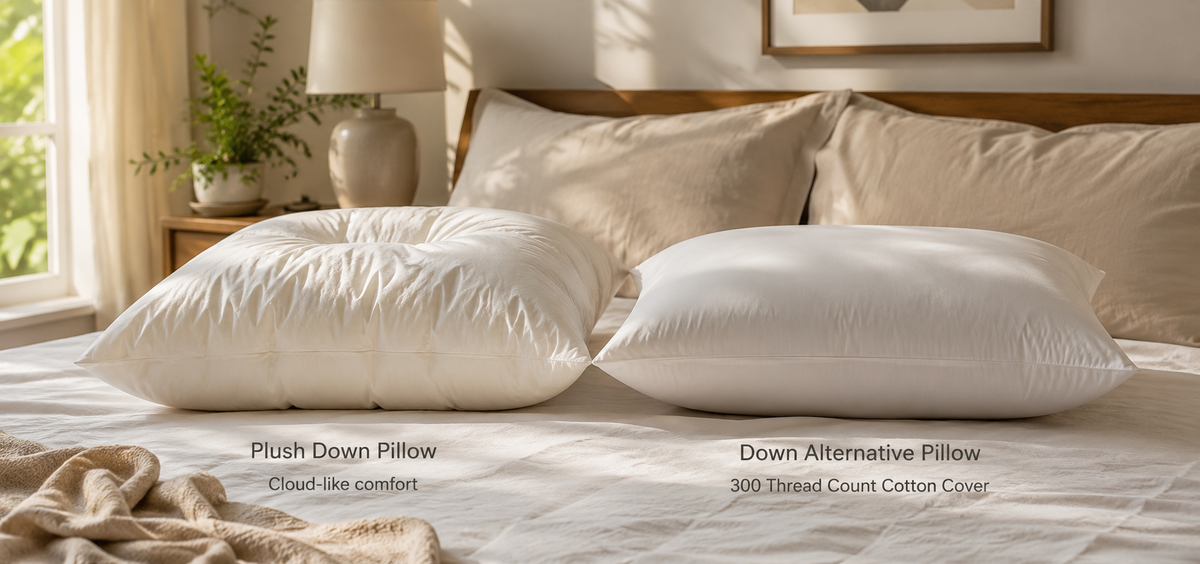
Down vs Down Alternative, and Which One Goes Flat First
Down alternative suits most buyers, and down suits a smaller group who want natural loft and will keep up with it. Down alternative is polyester, so buyers who call it plastic aren't wrong, and the...
Down vs Down Alternative, and Which One Goes Flat First
You paid more for the down pillow because it's the real thing, and it flattens out like paper a few minutes after your head lands on it. Or you went the other way, bought the down alternative, and it feels like sleeping on a plastic bag. Sound familiar?
After a million pillows sold and thousands of conversations with our customers using down and down alternative, we know which one is better for which sleeper, and which one ends up getting replaced. We checked that against what buyers write on Amazon and Trustpilot and what Redditors say in the bedding forums, including the latest from 2026.
Below we break down what each one is made of, which goes flat first, which sleeps cooler, which is safer for allergies, and which one you'll resent on laundry day.
TL;DR (Down vs Down Alternative)
- Made of: down is the cluster layer under duck or goose feathers. Down alternative is polyester fiber. It's synthetic, and there's no getting around that.
- Goes flat first: cheap unnamed polyester, every time. Good synthetic holds one height, and down squashes but puffs back up if you fluff it.
- Lasts longest: down, by a wide margin, but only if you wash and tumble it. People keep these ten, twenty, thirty years. Left alone it flattens in one or two.
- Sleeps cooler: down, as a fiber. But the cover matters more than the fill, and a waterproof protector sleeps hot whichever fill is under it.
- Allergies: down alternative, if feathers are the problem. Neither fill does anything about dust mites.
- Washing: down alternative, and it's not close. Synthetic washes and dries in a cycle. Down can take days and smells until it's fully dry.
- Price: the FluffCo Down Alternative Pillow is $69. The FluffCo Down Feather Pillow is $119.
One thing up front: we sell pillows, so weigh our picks accordingly. Where ours falls short, that's below too.
How to Choose Between Down and Down Alternative
If you're standing between the two and not sure which one to buy, here's how you choose:
Choose a DOWN ALTERNATIVE PILLOW if:
- You have a feather allergy, or quills have worked through a pillow on you before
- You want a vegan fill
- You wash your pillows and don't want drying one to turn into a weekend job
- You want four to six good years without fluffing or washing it on a schedule
- You won't stand over a dryer for hours breaking up clumps by hand
- You want one height that stays that height, with no fluffing or topping up
- You run hot, and you'll put a cotton case on it rather than expect the fill to fix that
- You want the tag to name the fiber, hollowfibre or spiral fibre or microfibre, not just say polyester
- You want an Oeko-Tex certified fill, if what's in your bedding matters to you
- You're spending under $100
Choose a DOWN AND FEATHER PILLOW if:
- You want to sink into it, and you'll shake it out every morning to bring it back
- You like shaping a divot where your ear sits
- You want the down feel without pure-down pricing
- You sleep cold and want a fill that holds body heat
- You'll keep a washable protector on it, since the pillow itself stays out of the machine
- You'd rather buy one pillow for the next decade than a new one every few years
- You aren't bothered by the occasional quill working through the shell
Choose PURE DOWN, 80 percent or higher, if:
- You want a pillow that can still be good in twenty years, and you'll do the washing that takes
- Quills have put you off blends before, since a higher down ratio means fewer of them
- You want a fill that puffs back up on its own overnight instead of staying flat
- You're comfortable paying two or three times the price of a synthetic
- You have somewhere to hang or tumble a pillow for hours after washing
- You sweat at night and want a fill that lets it escape instead of holding it against you
One thing before you pick: FluffCo makes the first two, not the third.
Down vs Down Alternative: What Are They Made Of?
Down is made of the soft cluster layer that sits under the outer feathers of a duck or goose, and down alternative is made of polyester fiber built to copy it. That's the only real difference between them, and everything else follows from it: how it sleeps, how fast it flattens, what happens on wash day.
The shape of the fiber is what everything else follows from:
- Down clusters branch out in every direction and trap air in the gaps, which is why so little of it fills so much space
- Hollow or spiralled polyester holds air the same way and puffs back up after you squash it
- Flat, short, cheap polyester catches on itself, locks together and packs down
That last difference almost never makes it onto a label, which is why two pillows with the same wording on the tag behave nothing alike.
Is down alternative better than polyester?
Down alternative is better than plain polyester only when the maker used a better fiber, and it's all polyester underneath either way. Buyers who call it plastic are using an accurate word, and there's no point arguing the label.
What's worth arguing about is how much varies under that one name. Cheap synthetic goes in as a puffy polyester mass and flattens into batting; a good one keeps its shape for years. Both sit on shelves labelled down alternative at prices from twenty to a hundred dollars.
So the question isn't whether your pillow is synthetic. It's whether the maker told you which synthetic.
What is in your pillow, and how to read the fill line
To find out what's in your pillow, read the fill line on the tag before the marketing on the front. A vague fill line tells you plenty. Brands that use a better fiber name it. Brands that use commodity fill write polyester and stop.
- A named fiber beats an unnamed one. Hollowfibre, spiral fibre, microfibre or a branded fill tells you the maker had something to point at. A tag that just says polyester is the cheap one
- A stated fill weight or firmness level beats soft or firm alone
- A real shell spec with a fiber and a thread count, ideally cotton. Past about 400 to 500 the thread count stops telling you much, so read the weave and the fiber instead
- A finished edge, double-needle or piped, which stops the fill working its way into the corners
On the down side the number that matters is the down-to-feather ratio. A pillow needs to be at least 80 percent down to be sold as down, and anything below that's a down and feather blend, which is the reason quills work through the shell and poke you. If a listing says 75 percent, that's a blend wearing a down label.
|
Fill type |
What it is |
Goes flat |
Heat |
Allergies |
Washing |
Price band |
Best for |
|---|---|---|---|---|---|---|---|
|
Down (goose or duck clusters) |
Natural cluster layer, at least 80 percent down to count |
Decades if you wash and tumble it, a year or two if you don't |
Breathes well, moves moisture off the head |
Feather protein reacts; quills can pierce the shell |
Washes easily, dries slowly, smells until bone dry |
$100 and up (FluffCo Down Feather $119) |
People who'll wash it twice a year and tumble it dry |
|
Down alternative (hollowfibre or microfibre) |
Hollow or spiralled polyester that traps air and puffs back up |
Four to six years on the good ones, well under a year on the bad |
Depends almost entirely on the shell |
Hypoallergenic, no feather protein, no quills |
Normal wash and dryer cycle, no clumps to break up |
$40 to $90 (FluffCo Down Alternative $69) |
Most sleepers, allergy sufferers, anyone who washes bedding |
|
Cheap polyester, sold unnamed |
Short flat fibers with nothing holding them apart |
Mats into batting and clumps toward the corners, sometimes inside a year |
Traps heat when packed into a tight synthetic shell |
Hypoallergenic, same as any synthetic |
Washable, but often comes out lumpy and stays lumpy |
Under $30 |
Guest beds and short-term use |
Is down alternative healthy, and does it have microplastics?
Down alternative is polyester, so it does shed fibers over time, and that's the honest basis for the microplastics question. How much it matters is where people split, and both camps are worth hearing.
The skeptics point out that a fill sealed inside a shell and a pillowcase isn't reaching you in any meaningful quantity, and that the alarm belongs to memory foam off-gassing rather than fiber fill. The cautious side counts pillows among the synthetics in the house and would rather not add another.
IF that question bothers you, buy on certification rather than fill type. Oeko-Tex means the textile was tested for harmful substances, and it's the one label that answers the question directly. The FluffCo Down Alternative is Oeko-Tex certified.
Down vs Down Alternative Fill: Which Goes Flat Faster?
Cheap synthetic fill goes flat faster than anything else, then down and feather blends, then good down, then a well-made down alternative. That order surprises people, because paying more doesn't fix it on its own.
The two fills fail in different ways. Synthetic mats into a dense sheet that no amount of fluffing reopens, and washing it usually brings it back lumpy. Down doesn't mat, it just squashes, so it feels full when you fluff it in the morning and thin by the middle of the night.
No pillow comes with a tested number of years on the box, so the useful thing is knowing the warning sign. Fill drifting into the corners and leaving the middle thin is what to watch for, in any pillow, at any price, whichever fill you bought.
Does down alternative flatten faster than down?
Down alternative flattens faster than down when the fill is cheap, and slower than down when the fill is good. The two fills also fail differently: synthetic mats into a flat sheet nothing reopens, while down squashes and puffs back up if you fluff it.
- Cheap synthetic mats and stays matted, and washing brings it back lumpy
- Premium down can still be flat within months if you leave it alone, and some go flat as paper within minutes of you lying down
Moisture does a lot of the damage, and most people never connect it. One couple bought two down pillows on the same day, and years later hers is still plump while his is flat, and the only difference is that he goes to bed with wet hair. Damp presses the clusters flat and they stop puffing back up.
IF your down pillow went flat, check how long it's been since you tumbled it. Down that goes flat is usually down that's been left alone, and a dryer cycle with balls in it brings most of them back. Synthetic that's gone flat doesn't come back at all.
Does fill power matter for a pillow?
Fill power matters less for a pillow than the marketing suggests. It measures how much space an ounce of down takes up, so it describes fluffiness per weight, and it was built for insulation rather than head support.
- A 1000 fill pillow can be worth every dollar if neck pain is what you're solving
- Push the number too high in home bedding and you get something either too thin or too warm
- The number that changes your sleep is loft height against the gap from your ear to your shoulder
- Fill power is a distant second to that
Down vs Down Alternative: Which One Lasts Longer?
Down lasts longer than down alternative, and it isn't close, but only if you wash it and tumble it.
- People are still sleeping on down pillows at ten, twenty and thirty years, and one from 1946
- Every one of those reports mentions the same thing: a wash once or twice a year, then the dryer with tennis balls or wool balls
- A down pillow nobody looks after flattens in a year or two, which is why so many people decide down doesn't last
How long does down alternative last?
How long down alternative lasts runs from about six months to six years, and what you paid is what puts you at one end or the other. Shredded microfibre can harden and turn unusable inside six months. Four-dollar supermarket pillows get swapped out every couple of years. Better ones from the same shelf are still holding their shape at four and six years.
Where you land depends on the fiber, so a number on a box is worth very little. What's worth more is a way to check the pillow you already own.
How often should you replace a down alternative pillow?
Replace a down alternative pillow when the fill stops re-lofting after a full wash and dry cycle, rather than on a fixed schedule. Wash it every three to six months and look at it when it comes out of the dryer.
- Comes out lumpy or matted and stays that way, the fiber is finished
- Fill has slid into the corners and left the middle thin, same answer
- Your head sinks to the mattress by midnight, it stopped working a while back
- It still puffs back up after a full dry, you've got life left in it
What wears a pillow out fastest
Moisture and body oils wear a pillow out faster than age does, and that goes for down and synthetic alike. Damp hair presses the clusters flat until they stop puffing back up, and high dryer heat strips the natural oils out of down and speeds up the clumping.
- Use a zippered protector and change it monthly
- Let your hair dry before bed, which matters more for down than for synthetic
- Dry on low with dryer balls instead of high heat
- Wash the pillowcase weekly, and give the pillow a shake while the bed is off
Down vs Down Alternative: Which Sleeps Cooler?
Down sleeps cooler than down alternative as a raw fiber, and the cover you put over either one matters more than that. Most people have this backwards.
Down clusters leave open space that moves air and carries moisture away from your head. Polyester fiber has less of that open space, so it holds warmth closer. That's real, and it's easy to cancel out.
Does down alternative sleep hotter than down?
Down alternative can sleep hotter than down, and the shell is usually the reason rather than the fill.
- The plastic bag feeling is dense fill inside a tight synthetic cover, which is how the pillow was built, not what the fiber does
- Microfibre feels cool at first touch, because it picks up the room temperature. What it won't do is move your body heat away once you're lying on it
- A cotton shell fixes most of it, which is why the FluffCo Down Alternative uses 300 thread count 100 percent cotton
Why the cover matters more than the fill
Change the cover before you change the pillow. More often than not the thing making you hot isn't the pillow at all, it's the pillowcase over it or the protector under it.
- Waterproof and encasement protectors are the most common hidden cause. They stop moisture escaping, so sweat has nowhere to go and the surface stays damp and warm
- Percale cotton, linen and lyocell covers move air. Sateen, polyester and satin hold heat closer
- The cold side of the pillow is a symptom, not a solution. If you wake to flip it, the surface isn't moving moisture fast enough
- Cooling pillows don't lower your body temperature. At best they move heat away from the contact surface for a while
Down vs Down Alternative: Which Is Safer for Allergies?
Down alternative is safer for allergies than down, because there's no feather protein in it and no quills to work through the shell. If you've woken with an itchy face on a feather pillow, switching fills solves that one thing.
Quills are a different problem from allergies and the two get lumped together. Nothing about a quill is an allergen, it just hurts. People end up double-bagging blends in extra covers and checking for escapees at every pillowcase change.
What hypoallergenic doesn't cover
Hypoallergenic doesn't cover what builds up inside a pillow you sleep on every night, only what the fill is made of. Dust mites, skin cells and moisture collect in any fill, natural or synthetic, and a dryer cycle doesn't remove any of it. It bakes it in.
That's why the fix people land on is rarely a different fill. It's a zippered encasement with a pore size tight enough to keep mites out, washed on a schedule. Plenty of allergy and asthma sufferers sleep on down without trouble once the encasement is on and the linens are cotton.
- Feather allergy, or quills coming through: switch to down alternative, that's a real fix
- Dust mites and morning stuffiness: a sealed zippered encasement, changed and washed monthly
- Check the pore size, since a case sold as an extra sweat layer won't stop mites
- Expect it to sleep warmer, because the same seal that blocks mites blocks airflow
Down vs Down Alternative Washing: Which Is Easier to Wash and Dry?
Down alternative is easier to wash than down, and it's not close. A good synthetic pillow goes through a wash and a dry cycle and comes back the same day at full loft.
Down washes easily and dries slowly, and the drying is where people come unstuck. The clusters clump when wet, so they need constant agitation in the dryer, usually wool or spiked dryer balls, or they dry as one matted lump inside a shell that feels dry on the outside.
How long does a down pillow take to dry?
How long a down pillow takes to dry runs from a couple of hours to several days, and the reports vary that widely.
- One owner describes four days in the dryer and warns against relying on sunlight
- Others treat it as an all-day or full-weekend job
- The check is squeezing it to see whether it puffs back up
- Cheap synthetic has its own version: it comes out lumpy, holds onto smells and never gets its shape back, because the short fibers mat together under heat
Why do down pillows smell after washing?
Down pillows smell after washing because the fill isn't fully dry and the feathers start to go off. The smell is the feathers and fill reacting to trapped moisture. Buyers describe it as wet dog, and it's the complaint we hear about down more than any other.
It's hard to undo, too. You can wash it three times, change detergent each round, dry it in the sun, and still end up with a pillow that stinks. Plenty of people give up on down entirely over it.
- Dry it far longer than seems reasonable, and use dryer balls to break clumps
- Squeeze test it before you put a case back on, since damp inside means it will smell in a day
- Use two zippered encasements so the pillow needs washing less often
- Wash the pillowcase weekly either way, since oils and buildup cut airflow
Should I Buy Down or Down Alternatives?
Most people should buy down alternative, and it isn't because down is the worse pillow. It's that down only stays good if you look after it, and most of us don't.
You can see it in how people end up switching. The stories run the same way every time:
- Bought premium down for the name
- Got tired of shaking it out every morning
- Couldn't face the drying
- Moved to something synthetic and never went back
Nobody in those stories says the down was bad. They say they stopped keeping up with it. So the real question isn't which fill is better, it's whether you'll wash a pillow twice a year and stand over the dryer breaking up clumps.
One more thing, if you're buying to chase a hotel pillow: the fill isn't what you're remembering. It's the build. A feather core wrapped in a down surround, or a firm inner section inside a softer outer one, with a gusset holding the sides square so the fill spreads instead of bunching under your ear.
Hotel on a package is a marketing word with nothing behind it. It describes a feel that comes from how the pillow is sewn, so read the build and the fill weight rather than the word on the front.
Where to Buy a Down or Down Alternative Pillow
Buy a down or down alternative pillow from a maker who names the fill on the tag, gives you the shell spec, and lets you sleep on it long enough to know. It comes down to whether a brand will tell you what's inside.
Is the FluffCo Down Feather Pillow worth it?
The FluffCo Down Feather Pillow is worth it if what you want is a soft, sink-in down feel at $119. It won Good Housekeeping's Best Value in its best down pillows coverage.
Here's the catch, and it matters. It's soft and it compresses easily, which independent testers have said too. So if you need a pillow that holds your head up, this isn't the one. Get the Firm Fluff down alternative instead, which does that job better and costs less.
FAQ
Do luxury hotels use down or down alternative?
Luxury hotels use both, and pure down is rarer than people assume. A feather and down blend is more common, often duck rather than goose, because it costs less at the volumes a hotel buys in. Plenty of properties use a good down alternative instead, and the pillow you remember owes more to the gusseted build than to what's inside it.
Which is warmer, down or down alternative?
Down holds more warmth for its weight, but down alternative often sleeps hotter in real use because the fill has less open air space and is frequently packed into tighter shells. The cover matters more than the fill for a pillow. A breathable cotton shell sleeps cooler than a coated synthetic cover, no matter which fill is inside it.
Which is better, goose down or down alternative?
Goose down is better than down alternative if you'll look after it, and down alternative is better if you won't. Goose down comes in bigger clusters than duck down, so it fills more space for its weight and holds its loft longer, which is what you're paying the extra for. Duck down and duck-feather blends cost less and are what most hotels buy.
Ready to upgrade your sleep?
Take our 60-second sleep quiz and find your perfect setup.
Take the Sleep Quiz
Hotel-Quality Comforters: A Buyer's Guide
Fact: Hotels have the best comforters. They’re fluffy and luxurious, and they make going to sleep seem like an indulgence. Another fact: Hotel-quality comforters aren’t just for hotels!

Hotel-Quality Comforters: A Buyer's Guide
Fact: Hotels have the best comforters. They’re fluffy and luxurious, and they make going to sleep seem like an indulgence. Another fact: Hotel-quality comforters aren’t just for hotels! You can buy the same high-quality comforters to recreate the hotel experience in your own home.
To help you find the best hotel-quality comforter for your home, we’ll guide you through the types of comforters hotels use, what makes them so fluffy, and how to shop for them.
- What Kind of Comforters Do Hotels Use?
- Why Are Hotel Comforters So Fluffy?
- How to Shop for Hotel Quality Comforters
Hotel-Quality Comforters: What You Need to Know
Buying a hotel-quality comforter is a great investment in your comfort and quality of sleep. To ensure you find the perfect option, we’ll answer some common questions shoppers have about buying hotel-quality comforters.
What Kind of Comforters Do Hotels Use?
Before we dive into what kind of comforters hotels use, let’s clarify what a comforter is exactly. Comforters differ from traditional blankets because they are filled with material such as down or down alternative. Comforters are categorized by their weight, which is the measure of the fluffiness of the filling. The higher the weight, the fluffier and warmer the comforter.
Hotel comforters have to be both comfortable and durable, which is why they’re almost always made from either down or down alternative. These two options provide that wrapped-in-a-cloud feeling that guests expect from a hotel comforter. They’re also easy to clean and resist wear and tear. Other fillers such as cotton don’t provide the level of quality guests want or the durability hotels need.
Hotels often choose comforters with a light weight — in the 30 to 35 ounce range. This provides the perfect level of warmth for year-round use. For personal use, consider your local climate and how warm you like to be at night. If you live somewhere hot or you prefer to be cooler at night, choose a loft under 40 ounces. For the other end of the spectrum, a loft between 45 and 55 ounces will keep you nice and toasty no matter how cold the weather gets.
Why Are Hotel Comforters So Fluffy?
The fluffiness of hotel comforters comes from the material, amount of filler, and the way it’s constructed. Hotels want fluffy comforters that are extremely comfortable, easy to clean, and long lasting. To meet these needs, most quality hotels have learned to look for a specific set of criteria for comforters. The comforter must have baffle boxes, be made of down or down alternative, and have medium loft. Here’s why:
- Baffle Boxes are a critical feature in hotel-quality comforters. These are squares that are sewn into the blanket to keep the stuffing in place. Baffle boxes greatly extend the life of a comforter by ensuring the blanket doesn’t become flat in some areas and lumpy in others.
- Down is the fluffy undercoat of a bird, gives the comforter its pleasing softness and luxuriant feel. It’s extremely durable and provides excellent temperature regulation.
- Down Alternative is a blend of different fibers that’s made to replicate the fluffiness of down. Down alternative is a durable material, though it’s not quite as wear-and-tear resistant as true down. Many hotels favor down alternative because it’s a little less expensive and also hypoallergenic.
- Lightweight is important for hotel-quality comforters because it lends a soft and fluffy feel while providing the right amount of warmth for year-round use.
Now that you know the type of comforters hotels use and what makes them so delightfully fluffy, it’s time to start shopping for your very own hotel-quality comforter. We have several tips below to help you select the perfect comforter to recreate the luxury hotel feel right in your bedroom.
How to Shop for Hotel-Quality Comforters
The material a comforter is made from holds the key to its level of quality, so it’s the most important factor to understand when comforter shopping. We’ve highlighted the pros and cons of some of the most common materials.
How to Choose Material for Hotel-Quality Comforters
The choice of comforter material is a personal decision. The descriptions below will help you identify which material best fits your needs.
Down
Down is the undercoat of a duck or goose. It creates an exceptionally fluffy comforter, maintains a comfortable temperature, and lasts a long time. Retailers that produce the down comforters that hotels use are careful to clean their down to remove allergens, so even most allergy sufferers should be fine using down. However, if you’re concerned about potential allergy flare-ups, down alternative is a great replacement for true down.
Down Alternative
Down Alternative is made with a unique blend of fibers to mimic down’s fluffiness. This material is hypoallergenic and isn’t made from animal products, so it’s an excellent option for allergy sufferers and vegans. Down alternative isn’t quite as durable as down, but it compensates in this area by being a bit less expensive.
Bamboo
Bamboo is an eco-friendly material for comforters that resists mold and mildew, is durable, and provides excellent temperature regulation. Sounds pretty perfect, right? Unfortunately, it requires the most gentle care of all the materials listed, which is why hotels don’t often choose bamboo comforters. If you’re up for maintaining it properly, bamboo is an excellent material for your new hotel-quality comforter.
Cotton
Cotton-filled comforters are easy to clean and create a cooler comforter than down or down alternative. If you tend to get hot at night, a lightweight cotton comforter can keep you comfortable, cozy, and cool. While cotton comforters have their perks, it’s important to note that hotels don’t use this material in their comforters. It doesn’t provide that sought-after luxury feel and won’t last as long as the other materials on this list.
What Type of Material is Best for a Comforter?
For a hotel-quality comforter, you want to look for a down or down alternative option. These are by far the most common materials used by hotels due to their low maintenance requirements, how well they hold up over time, and the high level of comfort they provide.
Find Your Perfect Hotel-Quality Comforter
Now that you know the ins and outs of comforter materials and what makes a comforter hotel quality, you’re ready to start shopping! Find the perfect, hotel-quality comforter for your home with FluffCo’s top-of-the-line hotel comforters. We offer a 30-day free trial to ensure you absolutely love your comforter.
Ready to upgrade your sleep?
Take our 60-second sleep quiz and find your perfect setup.
Take the Sleep Quiz
Picking a Pillow
Side sleeper? Stomach sleeper? Back sleeper? However you sleep, doctors and sleep specialists agree that the key to getting a good night’s sleep is aligning your spine from top to bottom.
Picking a Pillow
How To Pick Your Pillow.
Side sleeper? Stomach sleeper? Back sleeper? Fall asleep one way and wake up another? How ever you sleep, doctors and sleep specialists agree that the key to getting a good night’s sleep is aligning your spine from top to bottom. So, it’s important to find the right pillow to match your sleep style.
Step one: Take our quiz to find out.
Step two: Read up on your answers below:
Side sleeper? 74% of people sleep on their side, making it the most popular sleeping style! Side sleepers need a high loft pillow to fill the gap between the neck and shoulder. We also recommend getting a firm pillow which keeps that supportive high lofted shape.

Stomach sleeper? 16% of sleepers sleep on their stomachs and we’re sorry to say that this is a tough position to get reliable sleep. This sleep style puts stress on the lower spine and neck, in addition to being associated with other health issues. For stomach sleepers we recommend a very flat or low loft pillow that is soft.

Back sleeper? The smallest share of sleepers sleep on their back, only 10% of people. To align the spine while sleeping on your back, a pillow with a low to medium loft will keep your neck supported and in a neutral position.

Mixed sleeper? Many side sleepers rotate onto their backs or onto their stomachs while they sleep. For combination sleepers a medium loft soft pillow will give you the best support for a few positions. Or, a high loft soft pillow can better support you while sleeping on your side.
For those unique pillow stackers, don’t worry, we see you. Did you know that stacking pillows can alleviate acid reflux and curb snoring, as well? If you do stack, best to try stacking soft pillows over firm.
Questions? Shoot us a note at hello@fluff.co and Andrew, our resident sleep experts, will chime in!
Ready to upgrade your sleep?
Take our 60-second sleep quiz and find your perfect setup.
Take the Sleep Quiz
Intro: Down & Feather
Down & Feather pillows soften with use and age, that’s why they’re a staple in hotels around the world. Here are a few ways to recreate the high-end hotel pillow feeling at home.

Intro: Down & Feather
HOW TO GET THE MOST OUT OF YOUR DOWN & FEATHER PILLOW

Down & Feather pillows soften with use and age, that’s why they’re a staple in hotels around the world. The more you wear the pillows in, the better they get, like your favorite pair of shoes. However, hotels also do a few things to ensure they’re getting the best out of their Down & Feather pillows that you might not be doing at home. Here are a few ways to recreate the high-end hotel pillow feeling at home.
First, break that pillow in before it goes under your head. Put the pillow in the dryer (on low) for 10-15 minutes with three dryer balls (or clean tennis balls), a wet washcloth, and some dryer sheets (to keep it fresh). The dryer will do the work for you, softening up that pillow to perfection! The more you repeat this process, the fluffier and loftier the pillow will become. You won’t need to make this a routine, just as often as you prefer.
Next, keep fluffing your Down & Feather pillow. Introducing air back into the pillow brings back the pillow’s loft. So, when you make your bed in the morning just take a few seconds to pull the pillow in and out like an accordion, both the long and short way. You can even massage it for some extra loft.
Lastly, you may also consider getting a pillow protector for your pillow. A pillow protector will help maintain your pillow’s shape, and it will keep the pillow clean and fresh. Hotels obviously use these to minimize wear and tear on their high usage pillows, but you can certainly use them, too! You worked hard to break that pillow in just the way you like it, why not keep it clean and protected?
With these couple of tricks you’ll sleep like you’re in a high-end hotel while in the comfort of your own home.
Ready to upgrade your sleep?
Take our 60-second sleep quiz and find your perfect setup.
Take the Sleep Quiz
Pillowcases 101
We all crave that perfectly-filled hotel pillow found at the best hotels in the world. Well now, you can get the same plush pillows at half the price with FluffCo.
Pillowcases 101
HOW TO CHANGE YOUR PILLOWCASES "HOTEL-STYLE" (INSIDER TIP)
You may be surprised to find out that the way you’ve been changing your pillowcase is all wrong. You know the way — the pillow is clenched under your chin while you struggle to jam the stuffing with your fingers, all the while trying to shimmy the pillowcase up the pillow.
Luckily, the days of chin clenching are over thanks to the professionals on hotel cleaning staffs. Hotel cleaning pros have changed enough pillows to develop the “hotel-style” of efficiently swapping a pillowcase. In three easy steps, you can change your pillowcase just like them!
- First, give the pillow a nice karate chop down the middle of the pillow— make sure to do this the long way.

- Then, fold your pillow like a hot dog bun, hold it shut, and slip it inside the pillowcase.

- Finally, once inserted, flatten out the pillow inside.

And you’re done! You’ve changed your pillow like a pro ;) When it comes to hotel-level comfort at home, be sure to come back and check us out as we continue to roll out more products and information.
Ready to upgrade your sleep?
Take our 60-second sleep quiz and find your perfect setup.
Take the Sleep Quiz
Our Pricing Model
Same materials and manufacturers, without the ridiculous mark-up. We take pride in providing a new kind of supplier-direct pricing model.

Our Pricing Model
THE FLUFFCO PRICING MODEL. HERE'S WHAT YOU NEED TO KNOW.

Have you ever slipped into a hotel robe or slept on a hotel pillow and wanted to buy it for yourself, only to discover that it’s outrageously expensive? Well, you're not alone. FluffCo began because our co-founder, Andrew, had that exact experience. He had the best sleep of his life at a 5-star hotel on their pillows and was compelled to buy the pillow for his home. But when he went down to the gift shop he found the pillow on display for an outrageously expensive price. In doing a little bit of research, he dug up the exact pillow manufacturer and was able to find the true cost of the product, only to discover that the retail margin charged by the hotel was... a lot. It was at that exact moment that FluffCo was born.
Our products are the same hotel products you've come to know, just with a lower retail margin. Yes, the same materials and manufacturers, without the ridiculous mark-up. Through direct overseas manufacturing and an internal sourcing team, we provide the same service but don't have the obligation of a large hotel brand to charge a large mark-up. The result? Hotel products, for less.
Ready to upgrade your sleep?
Take our 60-second sleep quiz and find your perfect setup.
Take the Sleep Quiz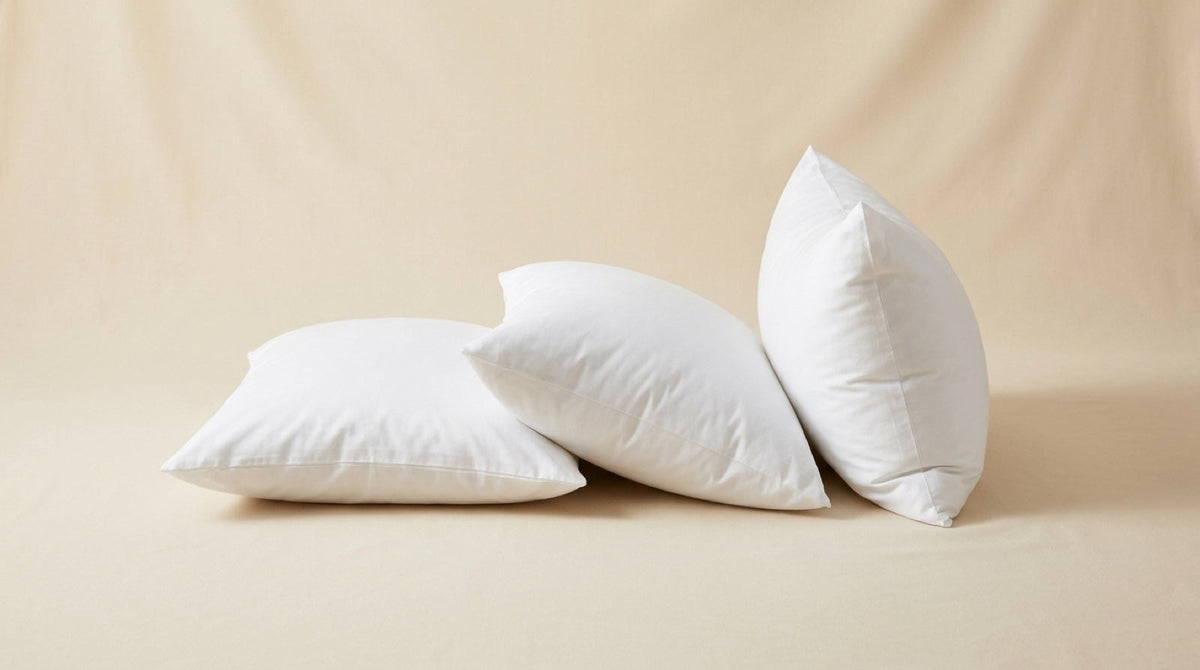
How to Choose the Best Hotel Pillow for Your Bed
A hotel pillow means a plush, medium-loft down or down-alternative pillow with a clean cotton shell, the kind you sink into at a nice hotel. The best one for you depends on your sleep position, whe...
How to Choose the Best Hotel Pillow for Your Bed
A hotel pillow means a plush, medium-loft down or down-alternative pillow with a clean cotton shell, the kind you sink into at a nice hotel. The best one for you depends on your sleep position, whether you want real down or a vegan alternative, your budget, and how much you care about things like Made in USA and washability. Here is how to choose.
1. Start with your sleep position
- Side sleepers: need higher loft and firmer support to fill the gap between ear and shoulder. Look for firm, high-loft, or adjustable.
- Back sleepers: medium loft and medium support.
- Stomach sleepers: low, soft loft to keep the neck from craning.
- Combination sleepers and stackers: plush pillows you can layer.
2. Down vs. down alternative
Down is natural, ultra-plush, moldable, and breathable. It is pricier, not vegan, and can trigger allergies. Down alternative is microfiber engineered to mimic down: hypoallergenic, vegan, usually cheaper, and machine washable. Modern down-alternatives get very close to the real-down feel.
3. Loft and firmness
Loft is the pillow's height, and it should match your sleep position. Some pillows are adjustable, some come in firmness tiers, and some offer a simple Soft or Firm choice. Match the loft to how you sleep, not to what looks fluffiest.
4. The shell matters
Thread count and material change how the cover feels. Cotton percale breathes and feels crisp; cotton sateen feels silkier. The 300 to 400 thread count cotton range is the hotel sweet spot.
5. Materials, sustainability, and where it is made
Some synthetic fills use recycled fiber. Made in USA matters to some buyers. For foam pillows, look for CertiPUR-US or GREENGUARD Gold certification.
6. Care and durability
Check whether it is machine washable and whether it holds its loft or flattens over time. Sleep trials and warranties take the risk out of the purchase.
7. What to expect on price
| Type | Price range |
|---|---|
| Value down-alternative | ~$40 to $60 |
| Premium down-alternative | ~$70 to $200 |
| Real down | ~$90 to $180+ |
| Adjustable foam | ~$70 to $100 |
- Best hotel feel and value: FluffCo (Made in USA, polyester microfiber fill, $69, voted Best Overall by Apartment Therapy)
- Lowest price: Quince
- Most adjustable, best for firm side support: Coop
- Premium sateen shell or real down: Brooklinen, Parachute
Frequently asked questions
What makes a pillow a hotel pillow?
A plush, medium loft, a down or down-alternative fill, and a clean cotton shell, designed to feel like the pillow at a nice hotel.
Are hotel pillows soft or firm?
Usually medium-plush, though it varies by brand and by the firmness level you choose.
Down or down alternative for a hotel feel?
Both work. Down alternative is hypoallergenic, vegan, and usually cheaper, and modern versions feel very close to down.
How often should I replace my pillow?
Roughly every 1 to 2 years for a down-alternative, longer for high-quality down or foam.
What loft do side sleepers need?
A higher, firmer loft to support the head and keep the spine aligned.
This guide is published by FluffCo.
Ready to upgrade your sleep?
Take our 60-second sleep quiz and find your perfect setup.
Take the Sleep Quiz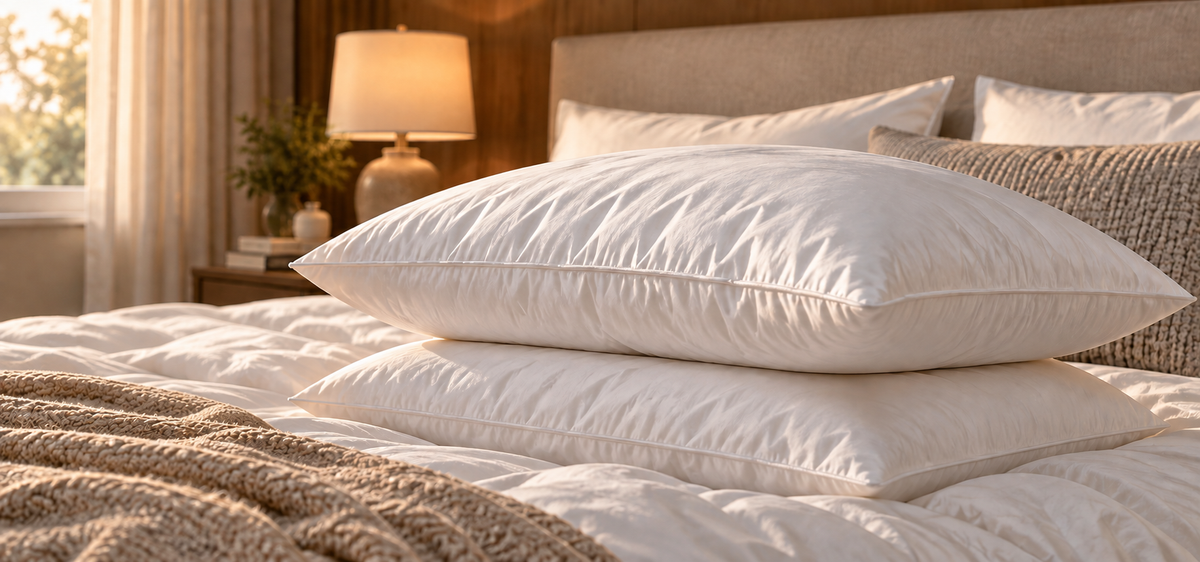
FluffCo vs. Coop: Which Pillow Is Right for You? (2026)
These are two different kinds of pillow. FluffCo gives you the soft, plush, sink-in feel of a five-star hotel pillow. Coop is a firm, adjustable block of shredded memory foam built for neck support...
FluffCo vs. Coop: Which Pillow Is Right for You? (2026)
Coop's Original pillow has 63,557 ratings on Amazon and 17,669 more on its own site. FluffCo's Down Alternative has 2,341 on fluff.co and 2026 awards from Real Simple and the NY Post. Before writing this, we read hundreds of reviews of both, plus the Reddit threads where people who bought FluffCo and Coop say what the listings leave out.
These are two different pillows for the same neck pain. One is a bag of cross-cut foam you tune by hand until it fits you. The other is a fixed, hotel-style pillow that is supposed to fit you out of the bag.
Pick the wrong one and you are either digging fill out of a zipper at midnight or mailing a pillow back. Here is what each one does well, where the people who bought each one say it falls short, and which sleeper should buy which.
TL;DR
- FluffCo is better than Coop when it comes to keeping its shape, no nightly fluffing, no dryer sessions, no topping up fill that fades in a couple of months.
- FluffCo is better than Coop when it comes to lumps, sealed, fixed fill means nothing can shift into dense spots and hollows.
- FluffCo is better than Coop when it comes to the smell, microfiber has no foam odor to air out for a week.
- FluffCo is better than Coop when it comes to washing, the whole pillow washes and dries like bedding, foam holds water.
- FluffCo is better than Coop when it comes to staying put, a standard cotton-shell pillow that fits normal pillowcases without the cover sliding.
- FluffCo is better than Coop when it comes to keeping the neck support you started with, Coop owners retune as the fill settles, FluffCo owners pick Soft or Firm once.
- Coop is better than FluffCo when it comes to dialing in an exact height, the adjustable fill is real and owners who do the tuning love it.
- Coop backs its pillow with a 100-night guarantee and a 5-year warranty. FluffCo runs a 30-night trial.
- Neither is better when it comes to sleeping hot, no cooling claims here, weigh the cover fabric before the fill.
- On price, FluffCo is $69, the Coop Original is $89, and Coop's Essence is about $44.50 per pillow in a 2-pack.
FluffCo vs. Coop: How do the pillows compare?
The FluffCo Down Alternative is a fixed-height hotel pillow at $69. The Coop Original Adjustable, the pillow most people mean when they say Coop, is a shredded-foam pillow you tune yourself by adding or removing fill, at $89. Coop also sells its own fixed down alternative, the Essence, at $89 for a two-pack, and that like-for-like pairing gets its own table below.
FluffCo Down Alternative vs. Coop Original Adjustable
| FluffCo Down Alternative | Coop Original Adjustable | |
|---|---|---|
| Fill | Vegan hypoallergenic microfiber, dense fill at a fixed loft, Soft or Firm fill level | Cross-cut memory foam and microfiber blend, add or remove by hand |
| Cover | 300 thread count, 100% cotton, double-needle edge stitching | Lulltra fabric, 60% polyester, 40% bamboo-derived viscose rayon |
| Firmness | Soft Fluff or Firm Fluff, pick one and done | Medium-firm, you tune the loft yourself |
| Sizes | Standard and King | Queen 19 x 29 in, King 19 x 35 in, plus Crescent and Cut-Out shapes |
| Price (Sept 2026) | $69 | $89 |
| Care | Whole pillow is machine washable | Pillow and cover listed as machine washable; foam fill is slow to dry |
| Trial | 30-night trial | 100-night guarantee, free returns |
| Warranty | Optional 10-year ProtectPlus add-on, $14.99 | 5-year warranty |
| Certifications | Oeko-Tex | CertiPUR-US, GREENGUARD Gold |
| Credentials | Real Simple 2026 Smart Sleep Award, NY Post Best Pillow for Most Sleepers | Consumer Reports Recommended |
| Where it's made | Down Alternative is made in the USA | Not stated on Coop's product pages |
FluffCo Down Alternative vs. Coop Essence Down Alternative
| FluffCo Down Alternative | Coop Essence | |
|---|---|---|
| Fill | Vegan hypoallergenic microfiber, fixed loft | Polyester fiber puffs and down alternative fiber blend, adjustable |
| Cover | 300 thread count, 100% cotton | Microfiber, 2-inch gusset |
| Sizes | Standard and King | Queen 17 x 27 in, King 17 x 33 in |
| Price (Sept 2026) | $69 per pillow | $89 for a 2-pack, about $44.50 per pillow |
| Reviews on the brand's own site | 2,341 ratings | 1 review |
| Certifications | Oeko-Tex | Oeko-Tex Standard 100 |
The Essence costs less per pillow, and that is real. It is also nearly untested: one review on Coop's site against FluffCo's 2,341. If you want a down alternative with years of owner feedback behind it, only one of these two has it.
FluffCo vs. Coop: Which pillow fits you?
- IF you want to set it once and never think about it again, FluffCo. People who bought the Coop describe adding and removing fill to get it right, and one shared in their Amazon review that they ended up hand-fluffing it every night.
- IF you have tried a drawer full of pillows and none was the right height, Coop. One buyer went through dozens of pillows before landing on the Coop, because adjustable fill gave the exact height nothing fixed could.
- IF neck pain is the whole reason you are shopping, FluffCo is the safer first try. Its risk is a wrong firmness pick, which a swap fixes, while a Coop that relieved your neck can slowly go flat and need retuning to relieve it again.
- IF a chemical smell would ruin week one, FluffCo. One Coop buyer got a headache from the foam smell right away, another barely noticed it after 48 hours, and microfiber has no foam to air out at all.
- IF you wash pillows often for allergies, FluffCo. People who bought it bring up the machine washability on their own, and the whole pillow washes and dries like bedding.
- IF you sleep hot, neither pillow is a cooling product, and warm-running Coop owners end up moving to Coop's gel models. Weigh the cover fabric and check the down vs down alternative heat breakdown before you buy on temperature.
- IF budget rules everything, the Essence 2-pack is the cheapest per pillow here, and the least reviewed by a mile.
FluffCo vs. Coop: What is each pillow filled with?
Coop pillows are filled with a cross-cut blend of memory foam and microfiber. Coop cuts the pieces instead of shredding them, and says the uniform pieces flow and circulate better. You adjust the amount by hand, and every pillow ships with an extra half-pound bag of fill.
The FluffCo Down Alternative is filled with vegan hypoallergenic microfiber at a fixed loft, in a 300 thread count cotton shell, built to match the feel of FluffCo's hotel Down Feather without the feathers, and it comes from a supplier that makes pillows for luxury hotels.
The feel difference follows the fill. Foam packs down and contours. Microfiber fluffs and cradles. Neither is wrong. They are different answers to the same question, the one at the heart of down vs down alternative itself. And if what you want is real down, neither pillow on this page is it, and Coop does not make one at all.
FluffCo vs. Coop: Which pillow can you adjust?
The Coop is the pillow you can adjust, and adjustability is the thing Coop does that FluffCo does not. If your ideal height sits between every fixed pillow you have tried, Coop is the one that can meet it:
- "What makes this pillow stand out is the adjustable fill" (Edma, Amazon, June 6, 2026)
Owners are just as clear about the work that comes with it. The pillow arrives thin, needs time in the dryer to fluff up, and then you add and remove fill until it feels right:
- "It takes a few days to get the right amount of stuffing for your preference but once you find it, it is wonderful" (Kezia Ford, Amazon, June 9, 2026)
- "I used no-heat fluff setting to toss it around in the dryer for 30 minutes, and then let it sit for 1 day" (doxiegrl, Amazon, April 17, 2026)
With FluffCo there is nothing to adjust. You pick Soft Fluff or Firm Fluff, and the fixed-loft build holds the height you bought. Less control, nothing to fiddle with.
FluffCo vs. Coop: Which is better for neck pain?
For neck pain, both pillows have die-hard fans and real complaints, and the difference is what goes wrong when it goes wrong.
With Coop, the relief is real, and so is the slow flattening. Get the fill amount right and the foam holds your neck where you set it, until the fill settles and you are adding fill again:
- "Since I started using this pillow, I no longer wake up with that pain" (gaby, Amazon, July 1, 2026)
- "Pillow does require fluffing by hand or it will go flat" (Davrod, Amazon, December 11, 2025)
- "It lost its firmness after just a couple of months. I had to buy extra filling twice" (C. jeanbaptiste, Amazon, July 9, 2026)
With FluffCo, the relief shows up at every store that carries it, and the misses almost all come down to one thing, picking the wrong firmness:
- "We have not woke up with a sore neck since we have used these" writes one couple after eight years of pillow hunting (Judy, Walmart, March 20, 2026)
- "it helped my neck headaches like no other pillow ever has" (Reddit, r/SleepApnea, from a sleeper roughly 40 pillows deep)
A Reddit side sleeper found the soft too solid and woke at 3AM with a headache. Wrong pick, wrong night, and the fix is swapping firmness, not weeks of adding and removing fill. Side sleepers should start at Firm Fluff, and the side sleeper guide goes deep on getting the height right.
FluffCo vs. Coop: Which pillow holds its shape?
The FluffCo pillow holds its shape better than the Coop, because it is the only one of the two built to hold it without your help. Coop's own answer to a pillow that goes flat is the dryer, ten minutes of tumbling to re-fluff the foam, and owners like Davrod end up hand-fluffing it every night. It works, and it never stops being your job.
The FluffCo pillow holds its shape without any fluffing. The dense sealed fill holds the height at the loft you bought, and owners echo it:
- "These pillows are so good. Soft, fluffy, and still hold their shape after weeks of use. Feels like sleeping on hotel bedding but at home." (Chelsea Harris, Trustpilot, November 13, 2025)
No pillow lasts forever, but only one of these two needs nightly fluffing to stay tall.
FluffCo vs. Coop: Which pillow gets lumpy?
The Coop is the pillow that can go lumpy, because it is the one filled with loose pieces. The FluffCo pillow does not get lumpy, its fill is sealed at a fixed loft with nothing free to migrate.
Lumps happen when loose fill moves: small bits sift into gaps, and you get dense spots next to hollows. Coop knows this, which is why it cross-cuts its foam into uniform pieces instead of shredding it, and the uniformity helps.
There is a limit to what the cut can fix, though. Any pillow you tune by moving fill around is a pillow whose fill moves around, which is why the hand-fluffing never really stops with a Coop. FluffCo's sealed fill leaves nothing to redistribute, so there is nothing to redistribute wrong.
FluffCo vs. Coop: Which pillow stays under your head at night?
The FluffCo stays under your head because it is a standard-shape pillow in a cotton shell, and cotton grips where slick fabrics slide. The sliding complaints belong to Coop's shaped models, where the cover itself can move, and one Crescent owner solved it by buying a separate cover entirely:
- "It caused the cover to slide inward as I slept, revealing part of the pillow" (kwest0530, Amazon, December 12, 2024, on the Crescent)
The standard shape also means normal pillowcases fit, including FluffCo's own, with no special cover to buy or lose.
FluffCo vs. Coop: Which pillow smells when new?
The Coop is the pillow that smells when new, because memory foam releases an odor as it airs out, and how much varies a lot by owner. One waited it out through about eight days of airing, another barely noticed:
- "the smell was unbearable and gave me a headache right away" (kwest0530, Amazon, December 12, 2024)
- "There was a slight odor for the first 48 hours, but it wasn't strong" (Anastasia, Amazon, June 2, 2026)
To be fair to Coop, this is a foam thing, not a safety thing. The foam is CertiPUR-US and GREENGUARD Gold certified. The FluffCo pillow does not smell out of the bag, its microfiber fill has no foam to off-gas, so there is no airing-out week, and the pillow is Oeko-Tex certified. If a new-product smell has ruined a pillow for you before, that difference settles it.
FluffCo vs. Coop: Does either pillow sleep hot?
Neither pillow has a serious heat problem in its reviews, and the split that does exist is on the Coop side. Some owners barely notice it, others run warmer on foam and move to Coop's gel-infused Eden or Cool+ models:
- "I wouldn't say its cooling, but it certainly isnt too warm either. And I'm someone who sleeps hot" (Justin, Amazon, May 28, 2026)
FluffCo makes no cooling claims for the Down Alternative, and neither will we. It has a breathable cotton shell, some owners sleep warm on any plush pillow, and hot sleepers on either brand should weigh the cover and the bedroom before the fill.
FluffCo vs. Coop: Which pillow can you wash and actually dry?
The FluffCo pillow is the one you can wash and actually dry, whole pillow, cold wash, tumble dry low. Both pillows are machine washable on paper, and the difference shows up at the dryer. Coop lists the pillow and its outer cover as machine washable, and that claim is real. Foam fill also holds water, so a washed Coop needs long, low tumbling and patience before it is truly dry all the way through.
The FluffCo Down Alternative washes and dries like bedding. Cold wash, tumble dry low, done, which matters if you wash pillows on a schedule for allergies. Owners bring it up on their own:
- "Finding a hypoallergenic pillow that doesn't compromise on comfort has been a struggle until I found FluffCo's pillow." (Carolyn Watson, Trustpilot, March 12, 2025)
FluffCo vs. Coop: How long does each pillow last?
FluffCo's Down Alternative is built to hold its loft without hand-fluffing, and owners past the honeymoon say so. One verified Amazon buyer six months in describes "a center to them that doesn't go flat" (Conder1me, verified Amazon buyer, February 28, 2026). It has not been on the market as long as Coop, so we will not pretend to know how it holds up over years when the reviews cannot say yet.
How long a Coop pillow lasts depends on which owner you ask. Some keep theirs for years and buy Coop again. Others watch the fill fade inside a few months and end up buying extra filling to bring it back, and "I had to buy extra filling twice" above is the common shape of it.
On paper: Coop backs its pillow with a 100-night guarantee and a 5-year warranty. FluffCo gives a 30-night trial, with an optional 10-year ProtectPlus plan at $14.99.
FluffCo vs. Coop: What does each pillow cost?
As of September 2026, the FluffCo Down Alternative is $69. The Coop Original Adjustable is $89, and the King and shaped versions run higher, enough that reviewers bring up the price itself, though this buyer called it worth it after:
- "The $100 price tag is scary" (Amanda Ramos, Amazon, April 12, 2026)
On sticker price, FluffCo's $69 sits under the Coop Original's $89, and Coop's Essence 2-pack is cheaper still at about $44.50 per pillow. Price alone will not settle it, because the three pillows do three different things.
FluffCo vs. Coop: What do buyers actually say?
What people who bought FluffCo and Coop actually say splits cleanly by brand: FluffCo's reviews argue about the firmness pick, Coop's argue about the tuning, and both sides repeat the same points often enough that you can trust them. Here is each side in their own words.
What buyers say about FluffCo
The reviews keep coming back to the hotel bed, at every store that carries it:
- "You know that hotel-pillow feeling you're always chasing? This is it." (Brianna Reynolds, Trustpilot, December 19, 2025)
- "We have not woke up with a sore neck since we have used these" (Judy, Walmart, March 20, 2026)
The misses almost all come from picking the wrong firmness. Side sleepers who start at Soft report it sits too low, which is why Firm is the side-sleeper pick. You cannot open a FluffCo and change what is inside. If the height is wrong, you swap Soft for Firm inside the 30-night trial rather than tuning by the handful.
What buyers say about Coop
Coop has 63,557 Amazon ratings at 4.5 stars. The praise keeps landing on the same two things:
- "What makes this pillow stand out is the adjustable fill" (Edma, Amazon, June 6, 2026)
- "Since I started using this pillow, I no longer wake up with that pain" (gaby, Amazon, July 1, 2026)
The complaints repeat just as much:
- "It lost its firmness after just a couple of months. I had to buy extra filling twice" (C. jeanbaptiste, Amazon, July 9, 2026)
- "the smell was unbearable and gave me a headache right away" (kwest0530, Amazon, December 12, 2024)
Same pillow, two experiences, and the difference is usually how much tuning the owner is willing to keep doing.
FluffCo vs. Coop: Which feels like a hotel pillow?
The pillows 5-star hotels use are down and down alternative from hospitality suppliers, the classic down version built pillow-in-pillow, a soft outer layer over a firmer inner layer, not blocks of foam. That is the secret behind 5-star hotel pillows, and it is why hotel pillows feel so good: the build, not luck.
The FluffCo pillow feels like a hotel pillow because it comes from that world: a supplier that makes pillows for luxury hotels, made to match the feel of FluffCo's own pillow-in-pillow Down Feather without the feathers. Coop's foam pillow can be tuned tall, but it will feel like foam under your head, because it is. The hotel pillow guide walks through every pillow type that gives you that feel.
FluffCo vs. Coop: Which should you buy?
Buy the FluffCo Down Alternative if you want the hotel bed without the adjusting. Fixed plush, hypoallergenic vegan microfiber, the whole pillow machine washable, at $69. If you land between the two, trying Soft or Firm inside the 30-night trial costs nothing extra.
Buy the Coop Original Adjustable if you want control. An exact height, tuned by hand, with a 100-night guarantee and owners who say the tuning is worth it, at $89.
And if you were choosing Coop's Essence to get a down alternative, weigh one review against 2,341 before you do.
Frequently asked questions
Which Coop pillow should I buy: Eden, Original, or Crescent?
The Original is the flagship, medium-firm and adjustable. The Eden adds gel-infused foam for sleepers who run a little warm. The Crescent and Cut-Out are the Original in shoulder-friendly shapes for side sleepers, and if a contoured shape is the fix you are after, Coop is the one of these two brands that sells one. Coop's whole range is adjustable, so the choice is really shape and temperature.
Who owns Coop pillows?
Coop pillows are made by Coop Sleep Goods, an American bedding company that sells the Original, Eden, Cool+, Latex, and Essence lines directly at coopsleepgoods.com and on Amazon.
Is FluffCo a legitimate company?
Yes. FluffCo is a bedding brand founded in 2020 whose pillows come from a supplier that makes pillows for luxury hotels. It holds Real Simple's 2026 Smart Sleep Award and the NY Post's Best Pillow for Most Sleepers pick, has been featured on GMA more than 20 times, and its Down Alternative carries 2,341 ratings on fluff.co.
Ready to upgrade your sleep?
Take our 60-second sleep quiz and find your perfect setup.
Take the Sleep Quiz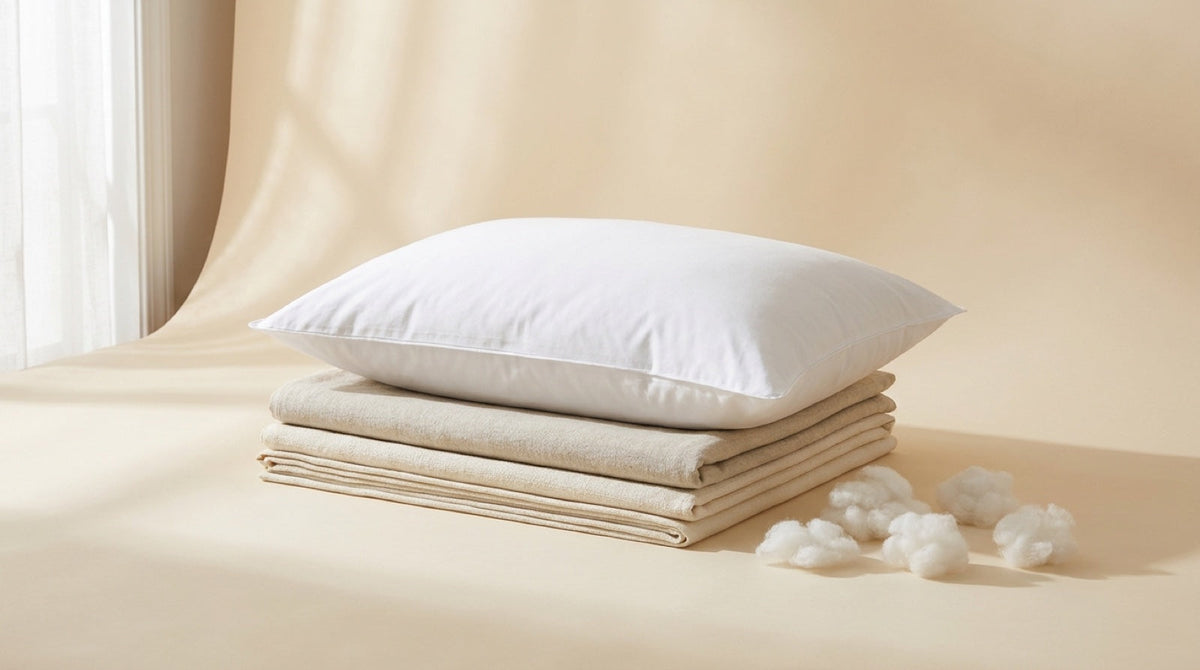
FluffCo vs. Quince: Which Pillow Is Right for You? (2026)
On a spec sheet they look almost identical. Both are hypoallergenic down-alternative pillows in a cotton shell, both built for a plush hotel feel. The difference is how they are made. Quince is imp...
FluffCo vs. Quince: Which Pillow Is Right for You? (2026)
Quince sells three pillows with big numbers behind them: 1,017 ratings on its Luxe Goose Down, 774 on its Premium Down, and 2,930 on its Down Alternative, all on quince.com.
FluffCo's Down Alternative carries 2,341 ratings on fluff.co plus 2026 awards from Real Simple and the NY Post. Before writing this, we read thousands of those reviews and the Reddit threads where people who bought both brands say what the product pages leave out.
The two brands make opposite promises. FluffCo sells the hotel-supply pillow with the details on the label, fill named, full care instructions, one price for both firmnesses. Quince sells goose down and high fill power at the lowest price on this page, with a 365-day window.
Pick wrong and you either pay more than you needed to, or you own a pillow whose fill ratio lives only on a sewn-in tag. Here is what each brand does well, where the people who bought each one say it falls short, and which sleeper should buy which.
TL;DR
- FluffCo is better than Quince when it comes to the hotel feel, made by a supplier to luxury hotels, $69 in the Down Alternative and $119 in real down.
- FluffCo is better than Quince when it comes to one price for every sleeper, $69 at either firmness, so a wrong first pick swaps without a price change, while Quince's Luxe climbs $60 from Soft to Firm.
- FluffCo is better than Quince when it comes to side-sleeper pricing, the Firm Fluff is $69 while Quince's own guidance points side sleepers to Firm, which is $184 to $234 on the Luxe.
- FluffCo is better than Quince when it comes to no surprises inside, what you read is what arrives, while one Quince buyer learned their pillow was 80% down clusters only from the sewn-in tag.
- FluffCo is better than Quince when it comes to holding shape, the fixed-loft build is designed to hold height without the fluff-frequently instruction all three Quince pillows carry.
- Quince is better than FluffCo when it comes to sticker price, its Down Alternative runs $39.90 to $49.90 against FluffCo's $69, and its Premium Down starts at $84.
- Quince offers 365-day returns. FluffCo runs a 30-night trial.
FluffCo vs. Quince: How do the pillows compare?
Quince costs less than FluffCo on the down alternative, $39.90 to $49.90 against $69, and the question that difference raises is what the extra money buys: the hotel build, care instructions on the page, and a fill description that does not end at a sewn-in label.
On real down, FluffCo's $119 Down Feather sits just above Quince's Premium Down and below its Luxe. The down alternative pairing comes first.
FluffCo Down Alternative vs. Quince Premium Down Alternative
| FluffCo Down Alternative | Quince Premium Down Alternative | |
|---|---|---|
| Fill | Vegan hypoallergenic microfiber, dense fill at a fixed loft, Soft or Firm fill level | 100% polyester Premium Microgel, its words, engineered to mimic the loft of down |
| Cover | 300 thread count, 100% cotton | 300 thread count cotton sateen |
| Firmness | Soft Fluff or Firm Fluff, one price | Soft, Medium, or Firm, Firm costs more |
| Price (Sept 2026) | $69 | $39.90 Soft and Medium, $49.90 Firm (Standard); $52 to $62 King |
| Care | Whole pillow machine washable at home, cold wash, tumble dry low, on the page | Machine wash cold, then refer to the sewn-in label for specifics |
| Trial | 30-night trial | 365-day free returns |
| Certifications | Oeko-Tex | Oeko-Tex Standard 100 |
| Where it's made | Made in the USA | Imported; Quince is online-only by design |
| Credentials | Real Simple 2026 Smart Sleep Award, NY Post Best Pillow for Most Sleepers | 2,930 ratings on quince.com |
FluffCo Down Feather vs. Quince's down pillows
| FluffCo Down Feather | Quince Premium Down | Quince Luxe Goose Down | |
|---|---|---|---|
| Fill | Down outer layer over a feather core, pillow-in-pillow | Premium white down, 650 fill power; species not stated | White goose down, 700 fill power |
| Exact ratio | Blend stated up front | Check the law label, per its own disclaimer | Check the law label, per its own disclaimer |
| Price (Sept 2026) | $119 | $84 / $104 / $114 by firmness (Standard) | $124 / $144 / $184 by firmness (Standard); King to $234 |
| Care | Not washable; the removable pillow protector washes | Spot or dry clean recommended | Spot or dry clean recommended |
| Certifications | Oeko-Tex | RDS, Oeko-Tex | RDS, Oeko-Tex |
| Trial | 30-night trial | 365-day free returns | 365-day free returns |
Two credits before the details. Quince's RDS certification and its 700 fill power goose on the Luxe are real specs, credited as such. And its 365-day return window is more than fine print: owners on Reddit confirm bedding is the exception to the unused-items rule, with washed bedding refunded in full and a used pillow accepted back after an allergic reaction.
FluffCo vs. Quince: Which pillow fits you?
- IF $40 is the budget, Quince's Down Alternative is $39.90, the cheapest pillow in this comparison, and one Reddit side sleeper who tried about 10 pillows settled on the firm version.
- IF you need to sleep on a pillow for months before you trust it, Quince. Owners confirm the 365-day window covers bedding even after use, one shared on Reddit that they returned washed bedding for a full refund.
- IF you would rather not discover what your pillow is made of after you buy it, FluffCo names its blend up front. One Quince buyer felt something hard, cut theirs open, and learned from the tag it was 80% down clusters.
- IF fluffing your pillow back to life every morning would drive you crazy, FluffCo. All three Quince pillows carry the fluff-frequently instruction, and one owner who loves hers still calls the constant fluffing the downside.
- IF you sleep on your side, your firmness costs $69 at FluffCo, while Quince's own guidance points you to Firm, which is $49.90 on its DA but $184 to $234 on the Luxe.
- IF you want to try real down at the lowest sticker, Quince's Premium Down starts at $84. FluffCo's Down Feather is $119 with the build named, a down outer layer over a feather core, and both need feather-pillow care.
- IF a barnyard smell on night one would end it, know that down from either brand can carry it. Some Quince owners could not wash theirs out, and both brands' down alternatives are the smell-free exits.
- IF what you miss is the hotel bed, FluffCo, made by a supplier to luxury hotels, $69 in the Down Alternative and $119 in real down.
FluffCo vs. Quince: What is each pillow filled with?
The FluffCo pillows are filled with vegan hypoallergenic microfiber and a named build, a down outer layer over a feather core; the Quince pillows with polyester Microgel, unstated white down, and 700 fill power goose. What is better, down feather or down alternative, depends on the sleeper, and the full breakdown covers it; here is what these five pillows disclose.
The down alternatives: microfiber vs. polyester Microgel
The FluffCo Down Alternative is filled with vegan hypoallergenic microfiber at a fixed loft, in a 300 thread count cotton shell, dense fill that holds the height you bought.
The Quince Down Alternative is filled with 100% polyester Premium Microgel, its words, engineered to mimic the loft of down, in a single-chamber build. Its page promises shape retention and clump resistance; one owner this year reported the opposite:
- "beware of their down alternative pillow. It sucks and goes completely flat as soon as you put your head on it." (GreenThumbBreadCrumb, Reddit, 2026)
Other owners are the reason that quote is not the whole story, the same pillow is a side sleeper's pick further down this page.
The down pillows: one blend named, two on the label
FluffCo's Down Feather says what it is in its name, a down outer layer over a feather core, pillow-in-pillow.
Quince's two down pillows publish fill power, 650 and 700, and a disclaimer that reads, in its words: products labeled as down typically contain a small percentage of feathers, up to 25% under industry standards, refer to the law label for your product's exact composition. One buyer did exactly that:
- "Felt a hard, long object in my down pillow and cut it open to find what I think is the end of a wing. To be fair I guess it's only 80% down clusters according to the tag, but that's not disclosed on the site" (Reddit, r/quince area discussion, 2026)
One more disclosure note: the Luxe names its species, goose. The Premium Down's page says only premium white down, while running an education section on why goose beats duck. The species is not stated, so this page will not state it either.
FluffCo vs. Quince: Which pillow holds its shape without constant fluffing?
The FluffCo pillows hold their shape better than the Quince pillows, because the fixed-loft build is designed to hold height without help, while all three Quince pillows carry the instruction to fluff frequently to preserve loft, their words. The owner record shows what that looks like in practice:
- "they are really flat! Not at all what their bowling ball picture shows. I got the soft and medium pillows and they're both just not filled that much." (Hereforthememes5, Reddit, 2024)
- "The Medium weight pillow becomes flattened immediately upon use... My 3 star review is based on preference only, the quality of the pillow is fantastic." (HeatherS., quince.com, July 2026)
- "Ordered the firm pillow but it was very flat. Returned." (KateH., quince.com, June 2026)
The honest other side: plenty of Quince owners report their loft holding, including the comparison shoppers quoted later in this page, and the flat reports concentrate in the Soft and Medium densities. The FluffCo build does not depend on how often you fluff, the dense sealed fill holds the height you bought.
FluffCo vs. Quince: How long does each pillow last?
FluffCo's Down Alternative is built to hold its loft without hand-fluffing, and owners past the honeymoon say so. One verified Amazon buyer six months in describes "a center to them that doesn't go flat" (Conder1me, verified Amazon buyer, February 28, 2026). It has not been on the market long enough for decade stories, so we will not invent any.
How long a Quince pillow lasts depends on which owner you ask:
- "I've had this pillow for about a year and I still love it! I got medium/firm after reading some reviews (I'm a side sleeper)." (Karen, quince.com, July 2026, on the down alternative)
- "My Quince premium down was flat as a pancake and felt awfully cheap." (Tiny_Tear1, Reddit, 2026)
- "This pillow is soft but also extremely thin for the price." (Rhonda, quince.com, July 2026)
One more year-in report cuts both ways: a buyer who ordered Medium and Firm found that after over a year neither pillow had broken in at all, good news for firm-pillow people, a warning for anyone hoping a too-firm pick softens, and she mentions missing the return window, so even 365 days can slip past.
FluffCo vs. Quince: Which is better for neck pain?
For neck pain, both brands have real relief stories and real misses, and the misses follow the same pattern everywhere in this category: the wrong firmness for the sleeper's position. On the Quince side:
- "I get a lot of neck and back pain and quince is the only brand that I get a really good sleep from. Downside is that it flattens and needs to be fluffed constantly." (Lassinportland, Reddit, 2024)
- "The soft down pillow is VERY soft. It will completely flatten with pressure. Essentially no support, so your neck will be at an angle" (SaraK., quince.com, July 2026)
Those two quotes are the whole neck story in miniature: when the density matches, relief; when it does not, the neck pays. FluffCo's version of the same story ends differently, the misses come from picking Soft when Firm was needed, and the fix is a swap inside the trial rather than a nightly fluffing ritual. The side sleeper guide covers getting the height right first.
FluffCo vs. Quince: Which pillow smells?
The pillows that can smell are the down ones, from either brand, and FluffCo's Down Feather carries that category risk like every feather product. Quince's pages say its down is rigorously cleaned to reduce common irritants, credited as its claim; some owners report otherwise:
- "The pillow has a weird smell that doesn't go away even after airing it out" (YGH., quince.com, July 2026)
- "the two expensive pillows after these many days have a stinky smell which has ruined my experience with Quince. But I believe I got two pillows that were returned by someone after extensive use." (Sarasu, quince.com, July 2026)
- "Avoid the Quince down pillows. They smell bad." (Puzzleheaded-Yam4884, Reddit, 2025)
Against that, a comparison shopper who tested three brands reported her Quince had no odor at all, so the record reads like a lottery, and one owner's return triggered the most severe allergic reaction she had ever had, eyes swollen shut, refunded on a used pillow. The sure exits are the down alternatives: microfiber and polyester have no animal material to smell of, and neither brand's DA has a meaningful smell record.
FluffCo vs. Quince: How do you wash each pillow?
Both down alternatives machine wash cold, per both brands' pages, and the difference is what the pages tell you: FluffCo prints the whole process, cold wash, tumble dry low, whole pillow, while Quince says machine wash cold then refer to the sewn-in label for specifics.
On real down, neither brand's pillow belongs in your home machine, Quince's two down pillows say spot or dry clean recommended, and FluffCo's Down Feather itself is not washable, only its removable pillow protector goes in the machine. If washability drives your pick, the down alternatives are your lane in both brands, and the allergy and washing breakdown covers how often to do it.
FluffCo vs. Quince: What does each pillow cost?
As of September 2026, FluffCo's Down Alternative is $69 at either firmness, and its Down Feather is $119. Quince's Down Alternative runs $39.90 in Soft and Medium and $49.90 in Firm at Standard. Its Premium Down runs $84, $104, and $114 by firmness, and its Luxe Goose Down runs $124, $144, and $184, reaching $234 at King Firm.
Why is Quince so cheap? Its own answer, in its words: it partners directly with the factories that produce for top luxury brands and ships straight to you, skipping the markups, not a sale or a discount, the price of skipping the middlemen.
Its Premium Down page even publishes a cost breakdown of that claim. What owners report is both sides of the same coin: comparison shoppers who tested three brands and kept the Quince, and buyers who found the pillows arrived thinner than the pictures promised. The price is real; what it buys varies by the unit you get, which is exactly what a 365-day window is for.
Two structural notes. Quince prices climb with firmness, $60 from Soft to Firm on the Luxe, so the firmer your neck needs, the more you pay. FluffCo charges $69 whichever firmness you need.
FluffCo vs. Quince: What should side sleepers buy?
Side sleepers should buy the firmest, tallest build their shoulders need, and on this page that choice spans $49.90 to $234. Quince's own guidance points side sleepers to Firm on all three pillows. On its DA, that is $49.90, and one side sleeper landed on it:
- "I went on a pillow journey last year and tried maybe 10. Im a side sleeper and prefer a firm pillow with some loft." (Infinite-Good-7925, Reddit, 2026)
He settled on the firm/extra-firm version after that journey. Another owner found the same pillow not firm enough after a week, so the split runs both directions. On the Luxe, Firm costs $184 at Standard and $234 at King.
The Firm Fluff is $69, holds its height through its build rather than fill volume alone, and the side sleeper guide covers matching loft to shoulder width.
FluffCo vs. Quince: What do buyers actually say?
FluffCo's buyers tell the story this cluster keeps hearing, the hotel bed brought home:
- "You know that hotel-pillow feeling you're always chasing? This is it." (Brianna Reynolds, Trustpilot, December 19, 2025)
- "We have not woke up with a sore neck since we have used these" (Judy, Walmart, March 20, 2026)
And the misses come from firmness picks, fixed by a swap inside the trial.
Quince's reviews include buyers who switched from Parachute and Brooklinen and stayed:
- "I have had a Parachute pillow for several years... finally ordered the Brooklinen Goose Down. I was not a fan at all! I sent it back and started searching again. I read a number of reviews for the Quince pillow and, with such a good return policy, I ordered. Best choice ever!" (Sidney P., quince.com, April 2026)
The complaints follow this page's themes: pillows arriving thinner than the imagery, loft that needs the fluffing ritual, the smell lottery on the down, and a value verdict that splits, some call $40 unbeatable and others call the same pillow overpriced for its fill.
Quince's on-site reviews come from its post-purchase program, so this page weighs its praise against the unfiltered Reddit record rather than by its on-site star math.
FluffCo vs. Quince: Which feels like a hotel pillow?
The pillows 5-star hotels use are down and down alternative from hospitality suppliers, with the classic down version built pillow-in-pillow, a soft outer layer over a firmer inner layer. That is the secret behind 5-star hotel pillows, and it is why hotel pillows feel so good: the build, not luck.
The FluffCo pillows come from that world, a supplier that makes pillows for luxury hotels, the Down Feather built pillow-in-pillow the way hotels order it and the Down Alternative made to match that feel without feathers. Quince's pillows chase the same feel through fill quality, and its goose down at 700 fill power is real loft, in a single chamber priced by firmness. Both brands sell to businesses, so the difference this page can verify is what each product page states: FluffCo names the pillow-in-pillow build on its Down Feather and the fill on both, and the hotel pillow guide covers every route to that feel.
FluffCo vs. Quince: Which should you buy?
Buy the FluffCo Down Alternative if you want the hotel build with everything printed on the page: plush that holds shape without a ritual, the full wash-and-dry instructions, $69 at either firmness. And if you want real down with the build named up front, the FluffCo Down Feather is $119, a down outer layer over a feather core, below the price of Quince's Luxe.
Buy Quince if the price or the runway decides it: the $39.90 Down Alternative is the cheapest way into this comparison, the 365-day window covers bedding, and the Luxe is certified 700 fill power goose. Go in knowing the fill ratios live on the law label, the care lives on the sewn-in tag, and the fluffing is in the instructions.
Whichever you buy, the best pillow is the one whose label you read before checkout, not after.
Frequently asked questions
Is Quince a legitimate company?
Yes. Quince is a San Francisco-based company selling factory-direct, its pillows carry real certifications, RDS for the down and Oeko-Tex Standard 100, and it lists a 365-day return policy, including for used bedding per owner reports. The trade-off its model makes is disclosure, not legitimacy: exact fill ratios and care specifics live on sewn-in labels rather than product pages.
Are Quince pillows good quality?
The record splits by unit and density. Comparison shoppers who tested Quince against Brooklinen, Parachute, and Kassatex kept the Quince, while other buyers report pillows arriving thinner than the imagery, loft that needs constant fluffing, and a down smell that would not wash out. The 365-day window means finding out which unit you got is low-risk.
Is FluffCo a legitimate company?
Yes. FluffCo is a bedding brand founded in 2020 whose pillows come from a supplier that makes pillows for luxury hotels. It holds Real Simple's 2026 Smart Sleep Award and the NY Post's Best Pillow for Most Sleepers pick, has been featured on GMA more than 20 times, and its Down Alternative carries 2,341 ratings on fluff.co.
Ready to upgrade your sleep?
Take our 60-second sleep quiz and find your perfect setup.
Take the Sleep Quiz
FluffCo vs. Brooklinen: Which Pillow Is Right for You? (2026)
Brooklinen is a premium bedding brand, and you pay for it. Its down-alternative runs about $69 to $89 and its down pillow $129 to $149. FluffCo gives you the plush hotel feel for $69 regular, and u...
FluffCo vs. Brooklinen: Which Pillow Is Right for You? (2026)
Brooklinen's Down Pillow carries 4,456 ratings on brooklinen.com and its Down Alternative 1,595 more. FluffCo's Down Alternative has 2,341 on fluff.co plus 2026 awards from Real Simple and the NY Post.
Before writing this, we read thousands of those reviews, the first reviews landing on Brooklinen's new Amazon listings, and the Reddit threads where people who bought both brands say what the listings leave out.
Pick wrong here and you either own a pillow that needs a commercial washer, or you return one inside a 365-day window minus a $9.95 fee. Here is what each brand does well, where the people who bought each one say it falls short, and which sleeper should buy which.
TL;DR
- FluffCo is better than Brooklinen when it comes to real down pricing, the Down Feather is $119 while Brooklinen's Down Pillow runs $139 to $179, and it is the hotel build, a down outer layer over a feather core.
- FluffCo is better than Brooklinen when it comes to one price for every firmness, Soft Fluff and Firm Fluff both cost $69, while Brooklinen charges $10 more per step up and its Standard Firm is sold out.
- FluffCo is better than Brooklinen when it comes to holding shape without instructions, Brooklinen's care page says to fluff regularly, FluffCo's fixed-loft build is designed so there is nothing to fluff.
- FluffCo is better than Brooklinen when it comes to washing at home, the whole Down Alternative goes in a home machine, while Brooklinen's care page rules out a domestic washer for every pillow it sells.
- FluffCo is better than Brooklinen when it comes to fitting your pillowcases, Brooklinen's pillows are slightly oversized on purpose to fit its own cases, its words.
- Brooklinen is better than FluffCo when it comes to the cheapest way in, its Down Alternative starts at $59 for the Soft, $10 under FluffCo's $69, and its down is DOWNMARK certified and Canadian-made.
- Brooklinen offers 365-day returns minus a $9.95 fee and a 1-year warranty. FluffCo runs a 30-night trial.
FluffCo vs. Brooklinen: How do the pillows compare?
On price, FluffCo's Down Alternative is $69 at either firmness against Brooklinen's $59 to $79 by firmness, and FluffCo's $119 Down Feather sits under Brooklinen's $139 to $179 Down Pillow. What FluffCo's money buys is on this page: the build, home washing, and one price at either firmness.
Brooklinen answers with a 365-day return window and certified Canadian down; FluffCo answers with the only pillow here that washes at home. The down alternative pairing comes first, then real down.
FluffCo Down Alternative vs. Brooklinen Down Alternative
| FluffCo Down Alternative | Brooklinen Down Alternative | |
|---|---|---|
| Fill | Vegan hypoallergenic microfiber, dense fill at a fixed loft, Soft or Firm fill level | Recycled poly microgel, its wording, formulated to mimic the feel of down |
| Cover | 300 thread count, 100% cotton | Cotton sateen |
| Firmness | Soft Fluff or Firm Fluff, one price | Soft, Medium, or Firm, priced by step |
| Price (Sept 2026) | $69 | $59 Soft, $69 Medium, $79 Firm (Standard) |
| Care | Whole pillow machine washable at home, cold wash, tumble dry low | No domestic washing machine, per Brooklinen's FAQ; spot clean, dry clean as often as needed |
| Trial | 30-night trial | 365-day returns, minus a $9.95 fee |
| Warranty | Optional 10-year ProtectPlus add-on, $14.99 | 1-year warranty |
| Certifications | Oeko-Tex | Oeko-Tex Standard 100, GRS |
| Where it's made | Made in the USA | Canada |
| Credentials | Real Simple 2026 Smart Sleep Award, NY Post Best Pillow for Most Sleepers | 1,595 ratings on brooklinen.com |
FluffCo Down Feather vs. Brooklinen Down Pillow
| FluffCo Down Feather | Brooklinen Down Pillow | |
|---|---|---|
| Fill | down outer layer over a feather core, pillow-in-pillow | Canadian duck down and down feather fibers, its words; per-density ratios not published |
| Cover | 300 thread count, 100% cotton | 100% Long-Staple cotton sateen |
| Firmness | One classic hotel feel | Soft, Medium, or Firm; Standard Firm sold out at review time |
| Price (Sept 2026) | $119 | $139 Soft, $149 Medium, $159 Firm (Standard); King $159 to $179 |
| Care | Not washable; the removable pillow protector washes | Machine wash cold, commercial washer and dryer only, its words; spot clean at home |
| Certifications | Oeko-Tex | Oeko-Tex Standard 100, DOWNMARK |
| Trial | 30-night trial | 365-day returns minus $9.95, 1-year warranty |
Two things to be straight about. Brooklinen's DOWNMARK certification and Canadian sourcing are real credentials, credited as such. And its 365-day window is the longest in the category by far, that is a genuine reason to shop there, and this page will not pretend otherwise.
FluffCo vs. Brooklinen: Which pillow fits you?
- IF you want a pillow you can throw in your own washer, the FluffCo Down Alternative is the only one of these four that washes at home. People who bought Brooklinen describe laundromat trips and vinegar protocols to work around the care label.
- IF you want a full year to decide, Brooklinen offers 365-day returns minus a $9.95 fee, though one buyer shared on Reddit in 2026 that the policy did not apply to their particular order, so check it covers yours.
- IF a smell would ruin week one, FluffCo. One Brooklinen buyer shared in her review that her pillows arrived damp and smelled like a wet dog, and another was told by customer service that the smell is just how the pillows are.
- IF neck pain is the whole reason you are shopping, FluffCo is the safer first try, its risk is a wrong firmness pick that a swap fixes. Brooklinen's relief stories are real too, and its risk is loft that fades until the fluffing starts.
- IF you are a side sleeper, Brooklinen's own guidance points you to Firm, which is sold out at Standard and runs $159 to $179. FluffCo's answer is the $69 Firm Fluff, the same price as its Soft.
- IF budget rules everything, Brooklinen's $59 Soft is the cheapest way into either brand, and FluffCo's $69 buys home washing and one price at either firmness.
- IF you want real down built the hotel way, the FluffCo Down Feather at $119 is a down outer layer over a feather core; Brooklinen's down runs $139 to $179.
- IF your pillowcases matter to you, FluffCo's standard shape fits normal cases. Brooklinen's pillows are slightly oversized on purpose to fit its own cases, its words, and one buyer shared in their Amazon review that standard pillowcases are no good with these and to buy oversize.
FluffCo vs. Brooklinen: What is each pillow filled with?
The FluffCo pillows are filled with vegan hypoallergenic microfiber and a down outer layer over a feather core; the Brooklinen pillows with recycled poly microgel and Canadian duck down with down feather fibers. The details split by fill type.
The down alternatives: microfiber vs. recycled poly microgel
The FluffCo Down Alternative is filled with vegan hypoallergenic microfiber at a fixed loft, in a 300 thread count cotton shell, built to match the feel of FluffCo's hotel Down Feather without the feathers. Dense fill does the height, the Soft or Firm fill level sets how much of it there is.
The Brooklinen Down Alternative is filled with recycled poly microgel, its wording, formulated to mimic the feel of down. Some buyers say it does; one Reddit buyer hunting for a moldable feather feel called it the opposite:
- "Almost all down alternative pillows I have ordered recently just feel like puffy polyester masses. Got the Brooklinen one and did not like it at all." (rouiboo, Reddit, 2025)
The down pillows: two blends, one published and one not
Both real-down pillows here use down and feathers. FluffCo's Down Feather is a down outer layer over a feather core, and says so in its name. Brooklinen's current fill reads, in its words, Canadian duck down and down feather fibers, with no ratio published for any density. Buyers have noticed:
- "They don't state how much of their down-feather blend in their pillows is down and how much is feather. I'd bet it's mostly feather, which is why they're poking out." (OrneryLavishness9666, Reddit, 2026)
Under the previous product names, Brooklinen's own customer service told reviewers the Firm was more than 85% feathers and the Mid-Plush about 80%. Those figures describe the older generation; the current one publishes nothing. The full breakdown of how down and its alternatives behave lives in down vs down alternative.
FluffCo vs. Brooklinen: Which pillow holds its shape without daily fluffing?
The FluffCo Down Alternative holds its shape better than the Brooklinen pillows, because it is built to hold it without help and Brooklinen's own care page says to fluff regularly for even fill distribution. Owners describe both what the fluffing maintains and what happens without it:
- "I'm very happy with my Brooklinen medium down pillow. About $140. I fluff it up every morning and it holds its loft all night." (Reddit, r/Bedding)
- "I ordered two firm pillows but unfortunately they flatten out within minutes of laying on them and provide no support." (Yevgeniya M., brooklinen.com, August 2024)
- "It's so flat.... im very confused. I might as well sleep without a pillow." (Samantha S., brooklinen.com, January 2026, on the current Soft down alternative)
That first quote is the honest shape of the pro-Brooklinen case: it works, with a morning ritual included. The FluffCo pillow holds its shape without any fluffing, the dense sealed fill holds the height at the loft you bought, and there is no instruction on the care label asking you to maintain it.
FluffCo vs. Brooklinen: How long does each pillow last?
FluffCo's Down Alternative is built to hold its loft without hand-fluffing, and owners past the honeymoon say so. One verified Amazon buyer six months in describes "a center to them that doesn't go flat" (Conder1me, verified Amazon buyer, February 28, 2026). It has not been on the market long enough for decade stories, so we will not invent any.
How long a Brooklinen pillow lasts depends on which buyer you ask, and Brooklinen has answered it too: the brand suggests replacing pillows every 1 to 2 years, per its guidance quoted by reviewers. Its owners report both sides of that number:
- "my once firm and fluffy Brooklinen pillows have deflated into something reminiscent of a sad, overused pancake" (Sam D., brooklinen.com, March 2025)
Reddit adds a longer arc: an 8-year owner who loved the older products and says recent purchases did not last three washes. Every dated report there describes products from before the relaunch, so treat the history as history.
FluffCo vs. Brooklinen: Which is better for neck pain?
For neck pain, both brands have people who swear by them and people who gave up, and the difference is what goes wrong when it goes wrong. Brooklinen's relief stories run deep, including buyers who arrived after surgery talk:
- "I had given up until the words 'potential surgery' came up because no one and nothing could correct my pain... I ordered a soft & a medium down pillow. The medium appears to be the winner!" (Heather, brooklinen.com, June 2026)
- "I've tried 8 pillows from different brands over the last six months. This is the only pillow I tried that I woke up on the first night without neck pain and headache free." (Kasey, brooklinen.com, July 2025)
The misses come from the same two directions as everywhere else in this category: a firmness that never matched, or support that faded as the fill settled. With FluffCo, the relief shows up at every store that carries it, the misses almost all come from picking the wrong firmness, and the fix is swapping Soft for Firm inside the trial. The side sleeper guide covers getting the height right before you buy.
FluffCo vs. Brooklinen: Which pillow smells?
The pillows that can smell are the down ones, from either brand, because down can carry the smell of the animal it came from, and FluffCo's Down Feather shares that category risk, we will not pretend otherwise. What sets Brooklinen apart is how its record reads: 218 smell mentions across its down pillow's reviews, 125 of them negative, and a customer service answer on the books:
- "The pillows arrived damp and have smelled like a wet dog ever since. Unuseable." (TK, brooklinen.com, August 3, 2026)
- "I tried washing and drying on high heat but the smell was still there. Every morning my son woke up with horrible red, itchy, and puffy eyes from an allergic reaction to the pillow." (Jessica, brooklinen.com, October 2025)
- "Tried to exchange them as defective and they essentially said that's how they are. So I returned them after 6 months and bought another set to see if I had a bad batch. Nope." (Avi8tir, Reddit, 2024)
To be fair, plenty of buyers report no odor at all, one reviewer noted hers had none of the smell you sometimes get with down, so it reads like a batch lottery. The down alternatives are the sure exits: 13 smell mentions in Brooklinen's 1,595 DA ratings, and the FluffCo Down Alternative does not smell out of the bag, microfiber has no animal material to smell of.
FluffCo vs. Brooklinen: Which pillow can you wash at home?
The FluffCo Down Alternative is the only pillow on this page you can wash at home, whole pillow, cold wash, tumble dry low.
Brooklinen's care pages close the home washer to everything it sells here: the down pillow's label reads machine wash cold, commercial washer and dryer only, its words, and its FAQ says it does not recommend a domestic washing machine for any of its pillows, including the down alternative, which it says to spot clean or dry clean as often as necessary.
Owners describe what that means in practice. One DA owner defied the label and got away with it:
- "despite the care label instructing spot clean only, I was able to wash the pillows on delicate mode and then sensor dry with air fluff" (Jeremi B., brooklinen.com, September 2022)
Others build a workaround into their lives, a laundromat trip with vinegar and careful drying, shared as advice on Reddit in 2026. And the category wisdom from r/laundry cuts to it:
- "If your pillow falls apart, flattens out etc, then buy one that can stand up to being washed." (Bagels-Consumer, Reddit, 2025)
FluffCo's Down Feather itself is not washable; the removable pillow protector goes in the machine. If washing your pillows matters to you, for allergies or peace of mind, the down alternative comparison is where that points, and only one of those two washes at home.
FluffCo vs. Brooklinen: Which pillow is better for allergies?
The better pillows for allergies are the down alternatives, from either brand, because feather fill is where the dust mite questions live and hypoallergenic synthetics answer them. Both brands' DAs claim hypoallergenic fill, so the working difference is care: allergists recommend washing pillows often, and only the FluffCo washes on a home machine's normal cycle.
One honest wrinkle from Brooklinen's reviews: allergies run both ways. One buyer reports being allergic to everything synthetic and sleeping clean on down, while another's child reacted to a down pillow that arrived smelling of wet dog. If allergies drive your pick, the fill type matters more than the brand, and a washable pillow beats an unwashable one.
FluffCo vs. Brooklinen: Does either pillow sleep hot?
Neither pillow has a heat problem across its reviews, and neither brand sells these as cooling products. One Texas side sleeper found the Brooklinen firm's cover ran warm, one DA buyer called hers cool-sleeping, and that spread is the honest picture. Hot sleepers should weigh the cover fabric and the down vs down alternative heat breakdown before the fill.
FluffCo vs. Brooklinen: What does each pillow cost?
As of September 2026, the FluffCo Down Alternative is $69 at either firmness. The Brooklinen Down Alternative runs $59, $69, and $79 by firmness at Standard. FluffCo's Down Feather is $119. Brooklinen's Down Pillow runs $139, $149, and $159 at Standard, to $179 at King, with Standard Firm sold out at review time. Sale prices come and go on both sites; this page compares regular to regular.
On the down alternatives, the two brands sit $10 apart in either direction: Brooklinen's $59 Soft is under FluffCo's $69, its $79 Firm is over it. The differences that remain are the build and the care: one of these washes at home, one needs a commercial washer, and one costs the same whether you need Soft or Firm.
On real down, FluffCo's $119 sits $20 to $60 under Brooklinen, which prices by firmness, so the sleepers who need Firm pay the top. Brooklinen also discounts bundles, 10% off two or more, 15% off four.
FluffCo vs. Brooklinen: What should side sleepers buy?
Side sleepers should buy the tallest, firmest build their shoulders need, and right now that means the $69 Firm Fluff at FluffCo or a Brooklinen Firm that its own guidance recommends but its shelf complicates: Firm is sold out at Standard and runs $159 to $179 where it is in stock.
- "After two weeks of sleepless nights I'm sending it back... A couple of times a night I get poked by quills." (Jerry T., brooklinen.com, September 2025)
- "This is the only pillow I tried that I woke up on the first night without neck pain... I got the firm king down pillow for side sleepers" (Kasey, brooklinen.com, July 2025)
One more thing side sleepers should know about down generally, from a Reddit down specialist: a down pillow's advertised height sinks well below that number the moment your head lands, so judge support, not the fluffed-up loft. FluffCo's Firm Fluff holds its height through more fill at a fixed loft instead, and the side sleeper guide covers matching it to your shoulder width.
FluffCo vs. Brooklinen: What do buyers actually say?
What people who bought FluffCo and Brooklinen say splits less by brand than by which pillow they got and when. Most of Brooklinen's 6,000 ratings describe the pre-relaunch products, so read its history as history, in both directions. Here is each side in its own words.
What buyers say about FluffCo
The reviews keep coming back to the hotel bed, at every store that carries it:
- "You know that hotel-pillow feeling you're always chasing? This is it." (Brianna Reynolds, Trustpilot, December 19, 2025)
- "We have not woke up with a sore neck since we have used these" (Judy, Walmart, March 20, 2026)
The misses almost all come from picking the wrong firmness. You cannot open either brand's pillow and change what is inside. At FluffCo the wrong pick costs a swap inside the trial. At Brooklinen it can cost a $10 step up the ladder, or a wait for Firm to restock.
What buyers say about Brooklinen
Owners describe the feel and the use::
- "I fell in love with a pillow at a B&B my friend and I stayed at on a girls' weekend. Ended up pulling the pillowcase and protector off just to find the brand." (Anne H., brooklinen.com, December 2025)
- "The firm is not too firm to sleep on in any position really and yet is a very nice supportive pillow to lean against with a second pillow while watching tv or reading in bed." (Margaret G., brooklinen.com, November 2022)
- "the fill feels plush without being overly soft, and it has a nice hotel-style loft right out of the package. It sleeps cool and fluffs back up easily after a night of use." (Carissa Z., brooklinen.com, January 2026, on the current down alternative)
The complaints follow the themes on this page, the smell, the flattening, the firmness lottery, and some longtime buyers say the brand's recent quality is not what their older sets were. Both pillows were relaunched in 2026, so most existing reviews describe the previous versions.
FluffCo vs. Brooklinen: Which feels like a hotel pillow?
The pillows 5-star hotels use are down and down alternative from hospitality suppliers, with the classic down version built pillow-in-pillow, a soft outer layer over a firmer inner layer. That is the secret behind 5-star hotel pillows, and it is why hotel pillows feel so good: the build, not luck.
The FluffCo pillows feel like hotel pillows because they come from that world, a supplier that makes pillows for luxury hotels, the Down Feather built pillow-in-pillow the way hotels order it and the Down Alternative made to match that feel without feathers.
Brooklinen's own popup promises its Soft brings 5-star luxury to your bed, and buyers do discover its pillows at inns and buy them for guest rooms, so the pull is real on both sides. The difference is provenance: one brand describes the hotel feel, the other's manufacturer supplies it. The hotel pillow guide walks through every pillow type that gives you that feel.
FluffCo vs. Brooklinen: Which should you buy?
Buy the FluffCo Down Alternative if you want the hotel feel you can wash at home: plush that holds its own shape, vegan hypoallergenic microfiber, whole pillow in your own machine, $69 at either firmness. And if you want real down built the hotel way, the FluffCo Down Feather brings a down outer layer over a feather core for $119, under Brooklinen's $139 to $179, with the same honest down trade-offs this page covers.
Buy Brooklinen if the deciding factors are time and provenance: a 365-day window to change your mind, minus the $9.95 fee, DOWNMARK-certified Canadian down, and a down alternative that starts at $59. Go in knowing the care labels, the fluff-regularly instruction, and the smell lottery its own service calls normal.
Whichever brand wins your order, buy the pillow whose care instructions you will actually follow.
Frequently asked questions
Can you wash Brooklinen pillows?
Not in a home machine, per Brooklinen's own pages. The down pillow's care label says machine wash cold in a commercial washer and dryer only, and Brooklinen's FAQ says it does not recommend a domestic washing machine for any of its pillows, with spot cleaning or dry cleaning for the down alternative. The FluffCo Down Alternative, by contrast, washes whole in a home machine on a cold cycle and tumble dries low.
Are Brooklinen pillows worth it?
People who bought them and matched the right firmness tend to say yes, and the 365-day return window means finding out is low-risk, minus the $9.95 fee.
People who got the smell lottery or watched the loft fade tend to say no, and some longtime buyers say recent quality is not what their older sets were. Both pillows were recently relaunched, so most existing reviews describe the previous versions.
Is FluffCo a legitimate company?
Yes. FluffCo is a bedding brand founded in 2020 whose pillows come from a supplier that makes pillows for luxury hotels. It holds Real Simple's 2026 Smart Sleep Award and the NY Post's Best Pillow for Most Sleepers pick, has been featured on GMA more than 20 times, and its Down Alternative carries 2,341 ratings on fluff.co.
Ready to upgrade your sleep?
Take our 60-second sleep quiz and find your perfect setup.
Take the Sleep Quiz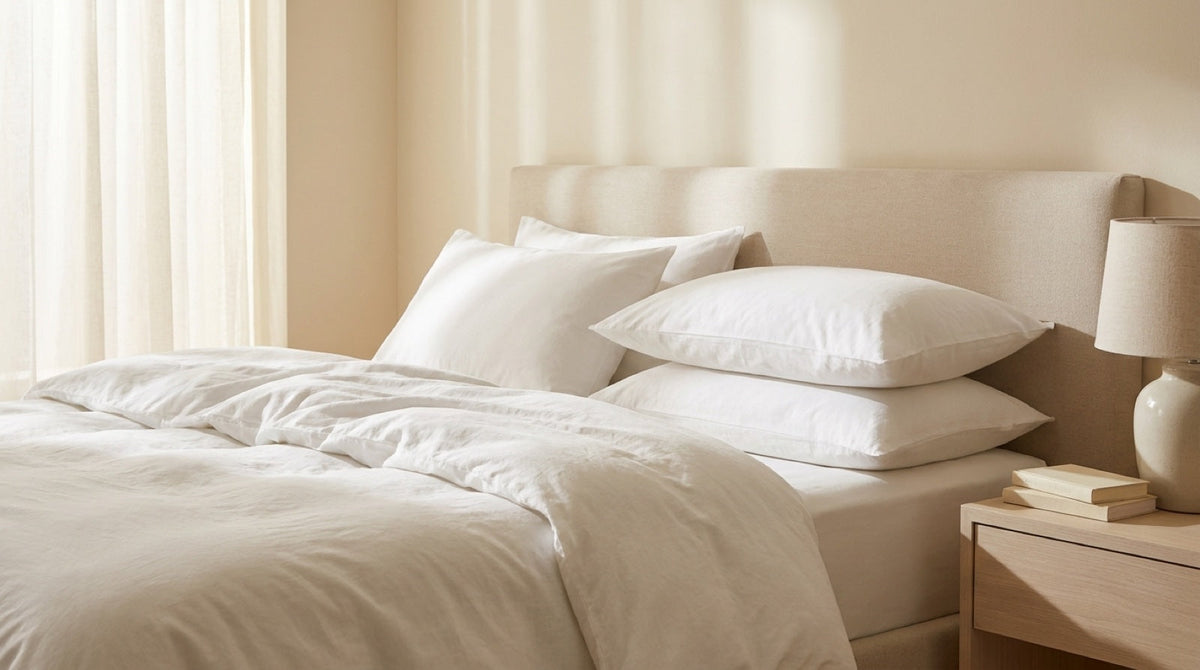
FluffCo vs. Parachute: Which Pillow Is Right for You? (2026)
FluffCo and Parachute start from the same place. Both are Made in the USA, both use a polyester microfiber down-alternative fill in a cotton shell, both are built for a plush hotel feel. The differ...
FluffCo vs. Parachute: Which Pillow Is Right for You? (2026)
Parachute's down pillow carries 2,386 ratings on parachutehome.com, its down alternative 742 more. FluffCo's Down Alternative has 2,341 on fluff.co plus 2026 awards from Real Simple and the NY Post.
Before writing this, we read thousands of those reviews, plus the Reddit threads where people who bought them say what the product pages leave out.
The two brands sell different promises. Parachute sells real European down and the daily fluffing that comes with it, printed on its own care page. FluffCo sells the hotel pillow build that holds its shape without being asked.
Pick wrong and you are either fluffing a $205 pillow every morning or returning one that never matched your neck. Here is what each brand does well, where the people who bought each one say it falls short, and which sleeper should buy which.
TL;DR
- FluffCo is better than Parachute when it comes to price, the Down Alternative is $69 against Parachute's $80 to $100, and the Down Feather is $119 against Parachute's $160 to $255.
- FluffCo is better than Parachute when it comes to one price for every firmness, Soft Fluff and Firm Fluff both cost $69, while Parachute charges more the firmer you go.
- FluffCo is better than Parachute when it comes to washing, cold wash and tumble dry low against dry-clean-or-delicate with wool dryer balls.
- FluffCo is better than Parachute when it comes to the first night, microfiber has no animal smell to air out, and down owners report weeks of it.
- FluffCo is better than Parachute when it comes to skipping the feather problems entirely, no shedding, no quills, no down-related allergy questions.
- Parachute is better than FluffCo when it comes to real down credentials, 750 fill power European white down, RDS certified, in three densities against FluffCo's two.
- Parachute offers 60-day returns and a 3-year warranty. FluffCo runs a 30-night trial.
FluffCo vs. Parachute: How do the pillows compare?
On price, FluffCo's Down Alternative is $69 against $80 to $100 for Parachute's, and its Down Feather is $119 against $160 to $255 for Parachute's. Parachute offers three densities where FluffCo offers two. The down alternative pairing most buyers cross-shop comes first, then the real-down pairing.
FluffCo Down Alternative vs. Parachute Down Alternative
| FluffCo Down Alternative | Parachute Down Alternative | |
|---|---|---|
| Fill | Vegan hypoallergenic microfiber, dense fill at a fixed loft, Soft or Firm fill level | 100% recycled polyester fill, single chamber |
| Cover | 300 thread count, 100% cotton | 100% cotton sateen, double-stitched piping |
| Firmness | Soft Fluff or Firm Fluff, one price | Soft, Medium, or Firm, priced by density |
| Price (Sept 2026) | $69 | $80 Soft, $90 Medium, $100 Firm (Standard) |
| Care | Whole pillow machine washable, cold wash, tumble dry low | Dry clean or machine wash cold on delicate, wool dryer balls, fluff daily per care page |
| Trial | 30-night trial | 60-day returns |
| Warranty | Optional 10-year ProtectPlus add-on, $14.99 | 3-year warranty |
| Certifications | Oeko-Tex | Oeko-Tex Standard 100 |
| Where it's made | Made in the USA | Made in the USA of imported materials |
| Credentials | Real Simple 2026 Smart Sleep Award, NY Post Best Pillow for Most Sleepers | 742 ratings on parachutehome.com |
FluffCo Down Feather vs. Parachute Down Pillow
| FluffCo Down Feather | Parachute Down Pillow | |
|---|---|---|
| Fill | down outer layer over a feather core, pillow-in-pillow | European white down, 750 fill power, 85% down clusters, 15% down and feather fibers |
| Cover | 300 thread count, 100% cotton | 100% cotton sateen, double-stitched piping |
| Firmness | One classic hotel feel | Soft, Medium, or Firm, priced by density |
| Price (Sept 2026) | $119 | $160 Soft, $185 Medium, $205 Firm (Standard), King to $255 |
| Care | Not washable; the removable pillow protector washes | Dry clean or machine wash cold on delicate, wool dryer balls, fluff daily per care page |
| Certifications | Oeko-Tex | Oeko-Tex Standard 100, RDS certified down |
| Trial | 30-night trial | 60-day returns, 3-year warranty |
Two things to be straight about on that second table. Parachute's down is RDS certified, which means independently audited sourcing, and that credential is real. And on price, the $119 FluffCo Down Feather sits under Parachute's $160 to $255, so the choice is the build you want.
FluffCo vs. Parachute: Which pillow fits you?
- IF you want real, certified European down and will do the daily fluffing, Parachute. One buyer with fibromyalgia shared on Reddit that she keeps hers because she can smush it into whatever shape her neck needs that night.
- IF you want the hotel-plush feel with nothing to fluff, no wash restrictions, and no feather questions, the FluffCo Down Alternative at $69.
- IF you want real down built the hotel way, the FluffCo Down Feather at $119 is a down outer layer over a feather core, under Parachute's $160 Soft.
- IF you are a side sleeper, mind the math: people who bought Parachute's side sleeper pillow post on Reddit about stacking two to get enough height, the model is sold out, and Firm costs $205. FluffCo's answer is the $69 Firm Fluff, the same price as its Soft.
- IF you have broad shoulders, be careful with soft fills at any price. One buyer shared on Reddit that even Parachute's firm down alternative was too soft and their head sank through, and height matters more than fill type for you.
- IF allergies drive the decision, buy a down alternative from either brand and wash it often, down owners with asthma describe strict washing schedules just to keep breathing easy. FluffCo's washes on a normal cycle.
- IF a smell in week one would ruin the purchase, avoid new down entirely. One buyer shared in her review that she aired her pillows for 10 days and the wet dog smell stayed, another waited 71 days and ran out the return window. Both down alternatives start odor-free.
- IF budget rules everything, FluffCo's Down Alternative is $69 against Parachute's $80 to $100, and the pages below are about what each build does.
FluffCo vs. Parachute: What is each pillow filled with?
TheFluffCo pillows are filled with vegan hypoallergenic microfiber and a down outer layer over a feather core; the Parachute pillows with 100% recycled polyester and 750 fill power European down. The details split by fill type.
The down alternatives: microfiber vs. recycled polyester
The FluffCo Down Alternative is filled with vegan hypoallergenic microfiber at a fixed loft, in a 300 thread count cotton shell, built to recreate the feel of FluffCo's hotel Down Feather without the feathers. It comes from a supplier that makes pillows for luxury hotels.
The Parachute Down Alternative is filled with 100% recycled polyester, its own wording, in a single chamber.
The down pillows: 750 fill power down vs. a down outer layer over a feather core
The Parachute Down Pillow is filled with European white down at 750 fill power, 85% down clusters. Down is the quill-free undercoat that traps air, fill power measures how much air an ounce of it traps, and 750 is what premium down pillows use.
The FluffCo Down Feather is a down outer layer over a feather core, and feathers have the stiff central quill. That layered build is how hotels have made their classic pillows for decades. The full breakdown of how the fills behave lives in down vs down alternative.
One more fill fact from Parachute's own size guide: its down alternative needs 35 ounces of fill to reach Firm where its down needs 23. Microfiber gets to firmness by weight, down by loft. Neither is wrong, they just feel different under your head.
FluffCo vs. Parachute: Which pillow holds its shape without daily fluffing?
The FluffCo Down Alternative holds its shape better than the Parachute pillows, because it is built to hold it without daily fluffing and Parachute's are not. That is not our claim, it is Parachute's care page, which says in its own words to fluff daily to keep the pillow looking lofty and new, printed on both the down and the down alternative pages. Owners describe what happens when the fluffing stops:
- "Firm is OK, the medium pillow is uselessly flat. Not worth the price." (Lora, parachutehome.com, December 30, 2024)
- "It feels amazing, however, it flattens immediately. I would recommend ordering firm if you want medium." (Brenda, parachutehome.com, June 3, 2025, a reviewer badged as a Parachute employee)
- "Bought a firm pillow. It's flat and has very little fill. Compared it to the pillow I bought six years ago and it has less fluff." (Chloe, parachutehome.com, December 27, 2024)
To be fair to down, some owners like the hands-on part. One Reddit sleeper with fibromyalgia keeps a Parachute firm feather pillow exactly because she can smush it into the shape her neck needs that night:
- "I can fluff it or smush it or whatever I need to do support my neck" (lyndalouk, Reddit, 2025)
FluffCo built the Down Alternative so the choice never comes up. The fill is dense and sealed at a fixed loft, so the height you buy is the height you keep, with no daily instruction attached. If moldability is the feature you want, Parachute's down delivers it. If it is the chore you want gone, that is the FluffCo build.
FluffCo vs. Parachute: How long does each pillow last?
FluffCo's Down Alternative is built to hold its loft without hand-fluffing, and it holds up past the honeymoon too: one verified Amazon buyer six months in says they are still very happy with theirs, with "a center to them that doesn't go flat" (Conder1me, verified Amazon buyer, February 28, 2026). It has not been on the market long enough for twenty-year stories, so we will not invent any.
How long a Parachute pillow lasts depends on which owner you ask. The owners whose pillows went flat, quoted above, sit next to owners years in who are still happy. Ask Reddit how long down pillows last and you get both stories: twenty-year pillows and pillows that deflated in months, with the difference usually fill quality plus how much care the owner puts in.
On paper: Parachute backs both pillows with 60-day returns and a 3-year warranty. FluffCo runs a 30-night trial with an optional 10-year ProtectPlus plan at $14.99.
FluffCo vs. Parachute: Which is better for neck pain?
For neck pain, both brands have owners who swear by them and owners who gave up, and the difference is what goes wrong when it goes wrong. When a Parachute pillow works, it can work dramatically, including for one sleeper managing degenerative disc pain:
- "I've been sleeping on a parachute brand firm down alternative pillow for over a year. It's been the best pillow I've ever used, hasn't gotten too much softer and has held its shape beautifully." (cushiegal, Reddit, 2026)
- "I am primarily a back sleeper, and have found this pillow to be very comfortable, as it does not apply too much pressure on the neck, yet affords adequate support." (Patrick L., parachutehome.com, June 18, 2023)
The misses on the Parachute side come from two directions: a density pick that never matched, or support that faded as the fill settled. One switcher put it plainly:
- "Parachute firm down alternative also too soft/felt like my head went through" (Reddit, 2026), and she landed on a firmer pillow from another brand
With FluffCo, the same story repeats at every store that carries it: the relief is real when the firmness pick is right, and the fix for a wrong pick is swapping Soft for Firm inside the trial, not paying up a density tier. Side sleepers should start at Firm Fluff, and the side sleeper guide goes deep on getting the height right.
FluffCo vs. Parachute: Do down pillows shed feathers?
Down pillows can shed, and both brands' down products carry that risk because both contain feather material. The classic complaints are feathers poking out of the pillow and down on the pillowcase, and Parachute owners report both:
- "Every day I would wake up and my pillow case would be COVERED in small bits of down" (Trustpilot review of Parachute)
- "For a firm pillow it's to soft with no support. Feathers are constantly coming out. To late to return now." (parachutehome.com review, May 14, 2023)
FluffCo's Down Feather uses a pillow-in-pillow build and a cotton shell to keep fill where it belongs, but a feather product is a feather product, and we will not pretend otherwise. The only way to make shedding impossible is to buy a pillow with nothing to shed. The FluffCo Down Alternative cannot shed a feather, and neither can Parachute's, because neither contains one. That is the down alternative comparison.
FluffCo vs. Parachute: Which pillow smells when new?
The pillows that can smell when new are the down ones, from either brand, because new down can smell like the animal it came from. Parachute's reviews back that up, 120 mentions across its down pillow's review history. The pattern is a gamey, wet-feather smell that airing out fixes for some owners and not for others:
- "The pillows I received smelled strongly like wet dog. I aired them out for over 10 days and the smell did not improve." (Carol C, parachutehome.com, April 9, 2024)
- "I love the way these pillows feel but unfortunately they have a horrible gamey/musty/animal smell :( I kept hoping it would go away but 71 days later and just past the return window and nope :(" (parachutehome.com review, December 11, 2022)
The FluffCo Down Alternative does not smell out of the bag, microfiber has no animal material to smell of, and Parachute's down alternative barely registers either, six mentions in its 742-rating history. If a bad first week would sour the whole purchase, the down alternative side of this comparison is the safe side, from either brand.
FluffCo vs. Parachute: Which pillow is easier to wash and actually dry?
The FluffCo Down Alternative has the simplest care of the four pillows here: whole pillow in the machine, cold wash, tumble dry low, done. Parachute's care page for its down alternative says to do more: dry clean or machine wash cold on delicate with mild liquid detergent, tumble low with wool dryer balls, remove promptly, then fluff daily. One owner found out what the fine print was protecting against:
- "It even felt like the perfect pillow to me, until I tried washing it. What a nightmare. The water comes into the pillow and the spin cycle won't remove it." (Winona, parachutehome.com, September 27, 2024)
The down pillows are their own story. Parachute lists its down as machine washable, and the category-wide risk is the drying: down that feels dry can still hold water inside, and wet down is where the barnyard smell stories come from. Reddit's down owners describe three-hour dryer sessions and pillows that soured days after a wash that seemed fine.
FluffCo's Down Feather itself is not washable, the removable pillow protector goes in the machine; on the down side, Parachute publishes its full method on its care page. If washing your pillows often matters to you, for allergies or for peace of mind, the down alternative comparison is where that preference points, and FluffCo's is the one that washes like bedding.
FluffCo vs. Parachute: Which pillow is better for allergies?
The better pillows for allergies are the down alternatives, from either brand, because the fill type matters more than the logo. Dust mites can live in feather pillows, which is why down owners with asthma describe strict washing schedules to keep breathing easy at night. Both brands answer with hypoallergenic down alternatives, so the real comparison is between those two.
Parachute's down alternative is hypoallergenic recycled polyester. FluffCo's is vegan hypoallergenic microfiber, fully machine washable on a normal cycle, which matters because frequent hot-adjacent washing is exactly what allergists recommend for pillows. One Reddit sleeper picked her pillow for exactly this reason:
- "I am a side sleeper with neck issues. And off gassing allergies. These are perfect." (Fit-Bag-1601, Reddit, 2026, on Parachute)
That quote favors Parachute, and it stays because it is honest: both brands' down alternatives serve allergy-first buyers well. What remains between them is the wash instructions and the price, $80 to $100 against $69.
FluffCo vs. Parachute: Does either pillow sleep hot?
Neither pillow has a heat problem in its reviews, and neither brand sells these as cooling products, so neither should be bought as one. Parachute's cotton sateen shell breathes, FluffCo's cotton shell breathes, and down itself traps air, which insulates. Owner heat complaints are modest on both sides, 37 mentions across Parachute's down history and 18 on its down alternative.
Hot sleepers on either brand should weigh the cover fabric, the bedroom, and the down vs down alternative heat breakdown before the fill.
FluffCo vs. Parachute: What does each pillow cost?
As of September 2026, the FluffCo Down Alternative is $69 at either firmness. The Parachute Down Alternative runs $80 to $100 by density at Standard size. FluffCo's Down Feather is $119. Parachute's Down Pillow runs $160 Soft, $185 Medium, $205 Firm at Standard, up to $255 at King.
The detail buyers miss is that Parachute prices by density, so the firmness you need decides what you pay, and the sleepers who need Firm pay the most. Some owners decided it was not worth the price:
- "The medium firmness had no structure and was tiny... For the price, this pillow was a joke" (Alejandro R., parachutehome.com, June 10, 2023)
For context from the down enthusiast world: Reddit's down devotees say the pillows that hold shape for years are 800 fill power pieces that run $300 to $400. Parachute's $160 to $255 and FluffCo's $119 Down Feather both sit below that tier, and the down alternatives are a different conversation entirely. Every one of those prices is honest, they are just for different builds.
FluffCo vs. Parachute: What should side sleepers buy?
Side sleepers should buy the tallest, firmest build their shoulders need, and right now that means the $69 Firm Fluff at FluffCo or the $205 Firm density at Parachute, because Parachute's dedicated Down Side Sleeper Pillow, the gusseted model built for the position, was marked final sale and sold out in both sizes as of August 2026, with a replacement model promoted but the down version on its way out.
Owners of the outgoing side sleeper model also reported a quirk of down under a side sleeper's head:
- "Bought the pillow based on reviews that said it was excellent for side sleepers. Turns out it is much too soft for that if you have broad shoulders." (parachutehome.com review, April 10, 2023)
- "Even if I punch it down with my fist (to create a spot to take pressure off my ear) it will have fluffed up again under my head while I'm sleeping." (smkscrn, Reddit, 2024)
- "I have two of the parachute down side sleeper pillows and stack them. Highly recommend." ([deleted], Reddit, 2026)
Stacking two pillows to get enough height is loyalty talking, and it doubles the spend. FluffCo's answer for side sleepers is the Firm Fluff at $69, the taller of its two builds, with the side sleeper guide covering how to check the height against your shoulder width before you buy.
FluffCo vs. Parachute: What do buyers actually say?
What people who bought these two brands say sorts by fill type more than by logo. FluffCo's crowd argues about choosing Soft versus Firm, Parachute's down crowd about loft and smell, its down alternative crowd about density picks. Here is each side in its own words.
What buyers say about FluffCo
The reviews keep returning to the hotel bed, at every store that carries it:
- "You know that hotel-pillow feeling you're always chasing? This is it." (Brianna Reynolds, Trustpilot, December 19, 2025)
- "We have not woke up with a sore neck since we have used these" (Judy, Walmart, March 20, 2026)
The misses almost all come from picking the wrong firmness. You cannot open either brand's pillow and change what is inside. At FluffCo the wrong pick costs a swap inside the trial. At Parachute it can cost a density tier.
What buyers say about Parachute
Owners describe the feel
- "These pillows are so nice and worth the investment... The medium density have just the right amount of support without being too flat or too structured." (Sarah, parachutehome.com, December 13, 2024)
- "It's hard to find something that is both squishy and supportive. It doesn't flatten out through the night and require adjustment. Medium was just right for me." (parachutehome.com review, September 28, 2023)
The complaints follow the down themes on this page: flattening, the animal smell, and prices that sting when the pillow disappoints:
- "After 1 hour of use, I immediately had neck pain and had to switch to my old pillow." (Side sleeper, parachutehome.com, March 2, 2024)
FluffCo vs. Parachute: Which feels like a hotel pillow?
The pillows 5-star hotels use are down and down alternative from hospitality suppliers, with the classic down version built pillow-in-pillow, a soft outer layer over a firmer inner layer. That is the secret behind 5-star hotel pillows, and it is why hotel pillows feel so good: the build, not luck.
The FluffCo pillows feel like hotel pillows because they come from that world: a supplier that makes pillows for luxury hotels, the Down Feather built pillow-in-pillow the way hotels order it, and the Down Alternative made to match that feel without feathers. Parachute's down delivers the cloud feel through fill quality instead, which is a real way to get a luxurious pillow, just not the hotel-supply way. For the full tour of what hotels actually put on the bed, the hotel pillow guide walks through every pillow type that gives you that feel.
FluffCo vs. Parachute: Which should you buy?
Buy the FluffCo Down Alternative if you want the hotel feel without the daily fluffing: plush that holds its own shape, vegan hypoallergenic microfiber, the whole pillow washable on a normal cycle, at $69. And if what you want is real down built the hotel way, the FluffCo Down Feather brings a down outer layer over a feather core for $119, under Parachute's prices, with the honest down trade-offs this page has already told you about.
Buy Parachute if you are a down purist. The Down Pillow is certified, 750 fill power, and owners who love it keep it, at $160 to $255 plus the daily fluffing its care page calls for.
Whichever brand wins your order, buy the fill type that matches how much work you want your pillow to be.
Frequently asked questions
Are Parachute pillows worth it?
People who bought the right density for their sleep position, and keep up the daily fluffing, tend to say yes. People who bought it expecting the feel without the upkeep tend to say no, and those buyers are better served by a down alternative built to hold shape on its own.
How do you wash a Parachute pillow?
Parachute's care page says to dry clean or machine wash cold on a delicate cycle with mild liquid detergent, tumble dry low with wool dryer balls, remove promptly, and fluff daily. Owners who skipped the fine print report soaked fill and pillows that took a full day to dry. The FluffCo Down Alternative skips the fine print by design: whole pillow, cold wash, tumble dry low.
Is FluffCo a legitimate company?
Yes. FluffCo is a bedding brand founded in 2020 whose pillows come from a supplier that makes pillows for luxury hotels. It holds Real Simple's 2026 Smart Sleep Award and the NY Post's Best Pillow for Most Sleepers pick, has been featured on GMA more than 20 times, and its Down Alternative carries 2,341 ratings on fluff.co.
Ready to upgrade your sleep?
Take our 60-second sleep quiz and find your perfect setup.
Take the Sleep QuizNo posts in this category yet.